

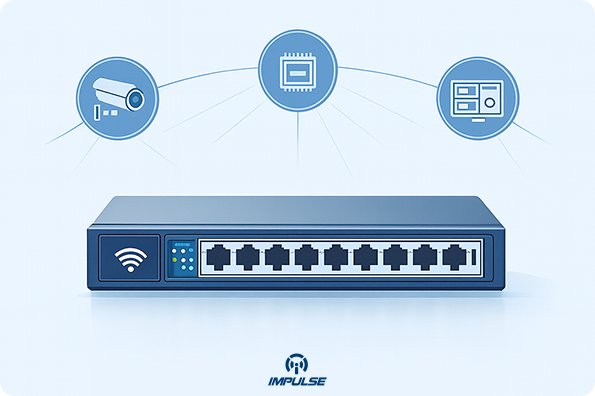
Picture this: Your security camera network is expanding faster than expected. New departments want coverage. Stakeholders demand 4K resolution. Your IT team is planning to add wireless access points across the facility. But here’s the problem your current PoE switch is maxed out, and you’re facing an expensive, disruptive upgrade far sooner than anticipated.
This scenario plays out in organizations every day, and it’s entirely preventable. The key? Understanding PoE switch scalability from the start. Whether you’re a system integrator designing surveillance networks, an IT professional managing infrastructure, or a business owner planning for growth, choosing the right Power over Ethernet (PoE) switch is a strategic investment that determines your network’s ability to evolve.
This comprehensive guide demystifies the PoE switch selection process, empowering you with the knowledge to make informed decisions that maximize scalability while optimizing performance and cost-efficiency. From understanding PoE standards to calculating power budgets and evaluating advanced management features, we’ll explore everything you need to build a robust, expandable network infrastructure that grows with your needs.
Understanding PoE Technology: The Foundation of Scalable Networks
Before diving into selection criteria, it’s essential to grasp the fundamentals of Power over Ethernet technology. PoE revolutionizes network deployment by transmitting both data and electrical power over a single Ethernet cable, eliminating the need for separate power sources for connected devices.
The Evolution of PoE Standards
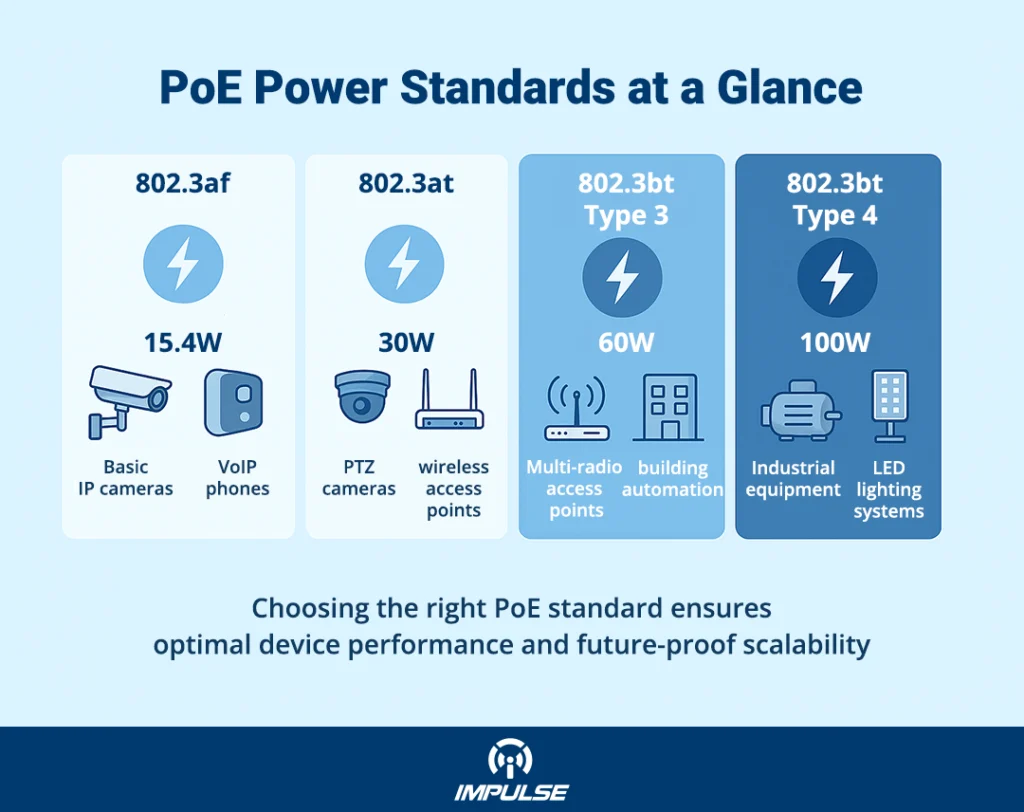
PoE standards have evolved significantly to meet growing power demands:
- IEEE 802.3af (PoE): Delivers up to 15.4 watts per port, suitable for basic IP cameras, VoIP phones, and simple access points
- IEEE 802.3at (PoE+): Provides up to 30 watts per port, powering PTZ cameras, high-performance wireless access points, and video phones
- IEEE 802.3bt Type 3 (PoE++): Supplies up to 60 watts per port for advanced devices like multi-radio access points and thin clients
- IEEE 802.3bt Type 4 (Ultra PoE): Offers up to 100 watts per port for power-hungry equipment such as LED lighting systems and industrial automation devices
Understanding these standards is crucial for choosing the right PoE switch that aligns with your device requirements and future expansion plans.
Key Factors for Maximizing PoE Switch Scalability
1. Port Count and Density Planning
The number of PoE ports directly impacts your network’s expansion capacity. When evaluating scalable PoE solutions, consider:
Current Requirements vs. Future Growth:
- Calculate your immediate device connections
- Project growth over the next 3-5 years
- Add a 20-30% buffer for unexpected expansion
Common Port Configurations:
- 8-Port PoE Switches : Ideal for small offices, branch locations, or targeted deployments
- 16-Port PoE Switches: Perfect balance for medium-sized installations requiring cost-effective performance
- 24-Port PoE Switches: Optimal for growing networks with significant expansion potential
- 48-Port PoE Switches : Enterprise-grade solutions for large-scale deployments
Impulse offers industrial-grade PoE switches engineered to withstand demanding environments while providing exceptional scalability.
2. Power Budget Calculation: The Scalability Cornerstone
PoE power budget represents the total power a switch can deliver across all ports. This critical specification determines how many devices you can actually power, regardless of available ports.
Strategic Power Budget Planning:
Step 1: Device Audit
- List all powered devices (IP cameras, access points, phones)
- Document each device’s power consumption
- Account for device upgrades and higher-power models
Step 2: Total Power Calculation
- Sum individual device power requirements
- Add 15-20% overhead for efficiency losses
- Include buffer for future high-power devices
Step 3: Switch Selection
- Choose switches with power budgets exceeding calculated needs
- Consider managed PoE switches with per-port power allocation
- Verify actual available power vs. theoretical maximum
Example Calculation:
- 16 IP cameras @ 8W each = 128W
- 8 wireless access points @ 15W each = 120W
- Total base requirement = 248W
- With 20% overhead = 297.6W
- Recommended switch: 370W+ power budget
3. Network Bandwidth and Data Throughput
While power delivery is crucial, network performance equally impacts scalability. High-resolution video surveillance, particularly 4K cameras and AI-powered analytics, demands substantial bandwidth.
Bandwidth Considerations:
Port Speed Options:
- Fast Ethernet (100 Mbps): Suitable for standard definition cameras and basic devices
- Gigabit Ethernet (1 Gbps): Essential for HD/4K cameras, high-traffic networks
- 10 Gigabit Uplinks: Critical for aggregating traffic from multiple switches
Backplane Capacity: The switch’s internal backplane must handle aggregate traffic from all ports simultaneously. A 48-port gigabit switch requires a minimum 96 Gbps backplane to prevent bottlenecks.
Switching Capacity: Measured in packets per second (pps), this specification indicates how quickly the switch processes data. Higher values ensure smooth video streaming without frame drops.
For comprehensive guidance on bandwidth planning, explore our article on using PoE switches for IP surveillance.
4. Managed vs. Unmanaged Switches: Control and Flexibility
Managed PoE switches provide advanced features essential for scalable, professional deployments:
Key Management Features:
VLAN (Virtual Local Area Network) Support:
- Segments network traffic for enhanced security
- Isolates surveillance traffic from general network data
- Enables efficient multicast video distribution
Quality of Service (QoS):
- Prioritizes critical traffic (video surveillance, VoIP)
- Prevents network congestion during high-traffic periods
- Ensures consistent performance for mission-critical applications
Port Monitoring and Control:
- Remote power cycling of frozen devices
- Per-port bandwidth allocation
- Traffic analysis and troubleshooting
SNMP (Simple Network Management Protocol):
- Centralized monitoring of switch health
- Automated alerts for power, temperature, or connectivity issues
- Integration with network management systems
Impulse’s managed PoE switches empower administrators with granular control over network operations, essential for maintaining peak performance as networks scale.
5. Environmental Durability: Industrial-Grade Reliability
For deployments in challenging environments, industrial-grade PoE switches are non-negotiable. These ruggedized solutions ensure uninterrupted operation regardless of external conditions.
Impulse Industrial-Grade Switches (IGS Series):
Ruggedized Construction:
- Operating temperature range: -40°C to 75°C
- Humidity resistance up to 95% (non-condensing)
- Shock and vibration tolerance for industrial environments
Enhanced Protection:
- IP-rated enclosures for outdoor installations
- Surge protection against electrical transients
- Fanless designs eliminating mechanical failure points
Applications:
- Manufacturing facilities
- Transportation infrastructure
- Outdoor surveillance networks
- Mining and oil & gas operations
- Smart city deployments
The Impulse IGS Series exemplifies industrial-grade excellence, delivering enterprise-level performance in the harshest conditions.
6. Advanced Features for Future-Proofing
Redundancy and Reliability:
Dual Power Inputs:
- Automatic failover between primary and backup power
- Essential for mission-critical surveillance applications
- Prevents downtime during power source failures
Ring Topology Support:
- Rapid Ring (R-Ring) for self-healing networks
- Sub-50ms recovery time from link failures
- Ideal for large-scale, distributed installations
Network Protection:
Port Security:
- MAC address filtering
- Protection against unauthorized device connections
- Essential for securing surveillance networks
Access Control Lists (ACLs):
- Granular traffic filtering
- Defense against network attacks
- Compliance with security standards
Broadcast Storm Control:
- Prevents network flooding
- Maintains stable operations during anomalies
- Critical for large switch deployments
7. PoE Passthrough and Daisy-Chaining
PoE passthrough enables switches to receive power via PoE while simultaneously powering downstream devices. This capability extends network reach without additional power sources.
Benefits:
- Simplified deployment in power-limited locations
- Reduced infrastructure costs
- Extended coverage for outdoor installations
Applications:
- Remote camera locations
- Perimeter security systems
- Parking lot surveillance networks
- Campus-wide wireless coverage
Selecting the Right PoE Switch Portfolio: Impulse Solutions
Impulse offers a comprehensive range of PoE network switches designed for diverse scalability requirements:
Entry-Level Scalability: Industrial-Grade Switches (IGS)
Impulse IGS Series:
- Compact, ruggedized design for demanding environments
- 4-10 Gigabit PoE ports with IEEE 802.3af/at compliance
- Dual DC power input for redundancy
- Operating temperature: -40°C to 75°C
- Perfect for small-to-medium outdoor deployments
Recommended Models:
- Impulse 6-Port Gigabit PoE Switch (IMP-IGS-1G06CG): Compact solution for focused deployments
- Impulse 10-Port Gigabit PoE Switch (IMP-IGS-1G10CP): Balanced power and port density
Mid-Range Scalability: Enterprise-Grade Switches (EGS)
Impulse EGS Series:
- High-density port configurations (24-48 ports)
- Advanced Layer 2/Layer 3 management features
- Gigabit uplinks and SFP+ connectivity
- Comprehensive security and QoS capabilities
- Ideal for medium-to-large enterprise networks
Recommended Models:
- Impulse 24-Port Gigabit PoE Switch (IMP-EGS-1G24P04X): Optimal for growing surveillance networks
- Impulse 48-Port Gigabit PoE Switch (IMP-EGS-1G48P04X): Maximum scalability for large installations
These 16-port and 24-port PoE solutions strike the perfect balance between cost-effectiveness and expansion capability.
Specialized Applications
High-Power PoE Requirements: For devices requiring PoE+ or PoE++ standards, Impulse offers switches supporting IEEE 802.3at and 802.3bt, delivering up to 30W or 60W per port respectively.
Fiber Uplink Connectivity: Models with SFP (Small Form-factor Pluggable) ports enable long-distance connections between switches, essential for campus-wide or multi-building deployments.
Best Practices for Scalable PoE Network Design
1. Hierarchical Network Architecture
Implement a three-tier architecture for maximum scalability:
Access Layer:
- PoE switches directly connected to devices
- High port density, moderate management features
- Cost-optimized for device connectivity
Distribution Layer:
- Aggregation of multiple access switches
- Advanced routing and VLAN management
- High-performance backplane capacity
Core Layer:
- Network backbone with maximum throughput
- Redundant connections for reliability
- Enterprise-grade management and security
2. Power Redundancy Planning
Strategies:
- Deploy switches with dual power inputs
- Implement UPS (Uninterruptible Power Supply) systems
- Consider PoE power injectors for critical devices
- Establish power priority hierarchies for essential cameras
3. Network Segmentation and VLANs
Benefits:
- Enhanced security by isolating traffic types
- Improved performance through broadcast domain reduction
- Simplified troubleshooting and maintenance
- Compliance with security frameworks
Implementation:
- Surveillance VLAN for IP cameras
- Management VLAN for administrative access
- Guest VLAN for visitor network access
- VoIP VLAN for unified communications
4. Documentation and Labeling
Maintain comprehensive network documentation:
- Physical and logical network diagrams
- Device inventory with power consumption data
- Port assignment schedules
- VLAN configurations and IP addressing schemes
Proper documentation accelerates troubleshooting and facilitates seamless expansion.
5. Future-Proofing Strategies
Key Considerations:
- Select switches with higher capacity than immediate needs
- Choose models supporting the latest PoE standards
- Prioritize switches with firmware update capabilities
- Invest in managed switches for growing networks
- Consider modular switches for maximum flexibility
Common Pitfalls to Avoid
1. Underestimating Power Requirements
Problem: Selecting switches based solely on port count without adequate power budget.
Solution: Always calculate total power needs and choose switches with 20-30% excess capacity.
2. Ignoring Network Bandwidth
Problem: Deploying Fast Ethernet switches for high-resolution surveillance systems.
Solution: Use Gigabit Ethernet for modern HD/4K camera installations and ensure adequate uplink bandwidth.
3. Overlooking Environmental Factors
Problem: Installing standard switches in outdoor or harsh environments.
Solution: Deploy industrial-grade PoE switches rated for temperature extremes and environmental hazards.
4. Neglecting Management Capabilities
Problem: Choosing unmanaged switches for complex, growing networks.
Solution: Invest in managed PoE switches that provide control, monitoring, and scalability features.
5. Failing to Plan for Growth
Problem: Selecting switches that meet only current requirements.
Solution: Always provision for 3-5 years of projected growth with appropriate port and power buffers.
Cost Optimization Without Compromising Scalability
1. Right-Sizing Your Investment
Approach:
- Conduct thorough needs assessment
- Prioritize managed switches for core locations
- Use unmanaged switches for static, simple deployments
- Leverage PoE+ only where genuinely required
2. Total Cost of Ownership (TCO) Analysis
Factors to Consider:
- Initial switch cost
- Installation labor savings (PoE vs. traditional power)
- Energy consumption and efficiency
- Maintenance and support costs
- Upgrade and expansion expenses
PoE switches typically offer lower TCO despite higher upfront costs due to simplified installation and reduced cabling infrastructure.
3. Phased Deployment Strategy
Implementation:
- Start with core infrastructure switches
- Gradually expand with access layer switches
- Leverage existing switches as network grows
- Maintain consistent vendor/model families for simplified management
Impulse: Your Partner in Scalable Network Solutions
Impulse distinguishes itself as a leader in industrial-grade video surveillance and PoE networking solutions. With a commitment to excellence spanning hardware, software, and support, Impulse delivers products engineered for long-term reliability and scalability.
Why Choose Impulse:
Global Certifications:
- UL® certified for North American markets
- FCC compliance for electromagnetic compatibility
- CE marking for European standards
- BIS (Bureau of Indian Standards) compliant
- Make in India certified
Comprehensive Product Range: From compact 4-port industrial switches to high-density 48-port enterprise solutions, Impulse offers PoE switches tailored to every scalability requirement.
Expert Support: Impulse’s technical specialists provide guidance throughout your project lifecycle from initial design and switch selection to ongoing support and maintenance.
Quality Assurance: Every Impulse product undergoes rigorous testing before release, with continuous firmware updates enhancing features, security, and reliability.
Industry Applications: Scalability in Action
Smart Cities and Public Safety
Requirements:
- Massive camera deployments across wide geographic areas
- Mix of indoor and outdoor installations
- Extreme temperature tolerance
- Centralized management and monitoring
Solution: Impulse Industrial-Grade Switches (IGS) with ring topology support for self-healing networks spanning entire municipalities.
Manufacturing and Industrial Facilities
Requirements:
- Harsh environmental conditions (dust, vibration, temperature)
- Critical uptime requirements
- Integration with automation systems
- Long-distance fiber connections
Solution: Ruggedized switches with dual power inputs, extended temperature ratings, and fiber SFP uplinks.
Corporate Campuses and Enterprises
Requirements:
- High device density (cameras, access points, VoIP phones)
- Advanced security and network segmentation
- Centralized management across multiple buildings
- Future expansion capabilities
Solution: Enterprise-Grade Switches (EGS) with comprehensive VLAN, QoS, and Layer 3 routing capabilities.
Transportation Infrastructure
Requirements:
- Linear deployments along highways, railways, tunnels
- Remote locations with limited power access
- Weather resistance and vandal-proof construction
- Rapid failover and redundancy
Solution: Industrial PoE switches with ring topology, PoE passthrough, and ruggedized enclosures.
For real-world implementation examples, explore our case studies showcasing successful deployments across diverse industries.
Emerging Trends in PoE Technology
1. Higher Power Standards
The IEEE continues developing standards for greater power delivery, with future specifications potentially reaching 200W+ per port. This evolution will enable PoE to power even more demanding devices like high-performance computers and charging stations.
2. Intelligent Power Management
Advanced switches now incorporate AI-driven power optimization, automatically adjusting power allocation based on device requirements and network conditions. This innovation maximizes power budget efficiency while ensuring critical devices receive priority.
3. PoE Lighting Integration
Smart building initiatives increasingly leverage PoE for LED lighting systems, converging lighting and networking infrastructure onto a single platform. This convergence simplifies installation and enables advanced lighting control through network management systems.
4. IoT and Edge Computing
The proliferation of IoT devices and edge computing applications drives demand for PoE switches supporting diverse device types with varying power requirements. Modern switches must accommodate everything from low-power sensors to high-power edge servers.
Stay informed about the future of PoE networking and how emerging technologies impact scalability planning.
Conclusion
Selecting the right PoE switch is a critical decision that profoundly impacts your network’s scalability, performance, and total cost of ownership. By carefully evaluating port count, power budget, bandwidth requirements, management features, and environmental considerations, you can architect a network infrastructure capable of supporting both current operations and future growth.
Key Takeaways:
✓ Calculate Power Budget Thoroughly: Ensure total power capacity exceeds device requirements by 20-30%
✓ Plan for Growth: Select switches with port and power buffers for 3-5 years of expansion
✓ Prioritize Bandwidth: Deploy Gigabit Ethernet for modern surveillance and high-traffic applications
✓ Choose Management Wisely: Invest in managed switches for professional deployments requiring control and visibility
✓ Consider Environment: Deploy industrial-grade solutions for outdoor and harsh condition installations
✓ Future-Proof Your Investment: Select switches supporting latest PoE standards and firmware updates
Impulse’s comprehensive portfolio of industrial-grade and enterprise PoE switches provides solutions for every scalability requirement from compact 4-port switches for focused deployments to robust 48-port systems for large-scale installations. With global certifications, ruggedized construction, and advanced management features, Impulse switches deliver the reliability and performance demanded by mission-critical applications.
The journey to a scalable, efficient network infrastructure begins with informed decision-making. By applying the principles outlined in this guide and partnering with experienced manufacturers like Impulse CCTV, you can confidently build networks that not only meet today’s demands but seamlessly adapt to tomorrow’s challenges.