


The surveillance industry stands at the precipice of a wireless revolution. For years, security professionals have grappled with the limitations of traditional wired infrastructure expensive installation costs, inflexible deployment options, and the logistical nightmare of cable management across sprawling facilities. Enter Wi-Fi 7 (IEEE 802.11be), the latest wireless standard that promises to fundamentally transform how we approach real-time surveillance systems.
With theoretical speeds reaching up to 46 Gbps and ultra-low latency capabilities, Wi-Fi 7 isn’t just an incremental upgrade it’s a paradigm shift. This technology addresses the most critical challenge in wireless surveillance: maintaining consistent, real-time video transmission without the lag, buffering, or quality degradation that plagued previous wireless generations.
As enterprises increasingly demand flexible, scalable security solutions, understanding Wi-Fi 7’s technical advantages becomes essential for security architects, system integrators, and IT professionals planning their next-generation surveillance infrastructure.
Understanding Wi-Fi 7: The Technical Foundation
What Makes Wi-Fi 7 Revolutionary?
Wi-Fi 7, also known as IEEE 802.11be Extremely High Throughput (EHT), represents the seventh generation of wireless networking technology. Officially introduced by the Wi-Fi Alliance in 2024, this standard brings several groundbreaking enhancements specifically designed to support bandwidth-intensive, latency-sensitive applications like video surveillance.
The core innovations include:
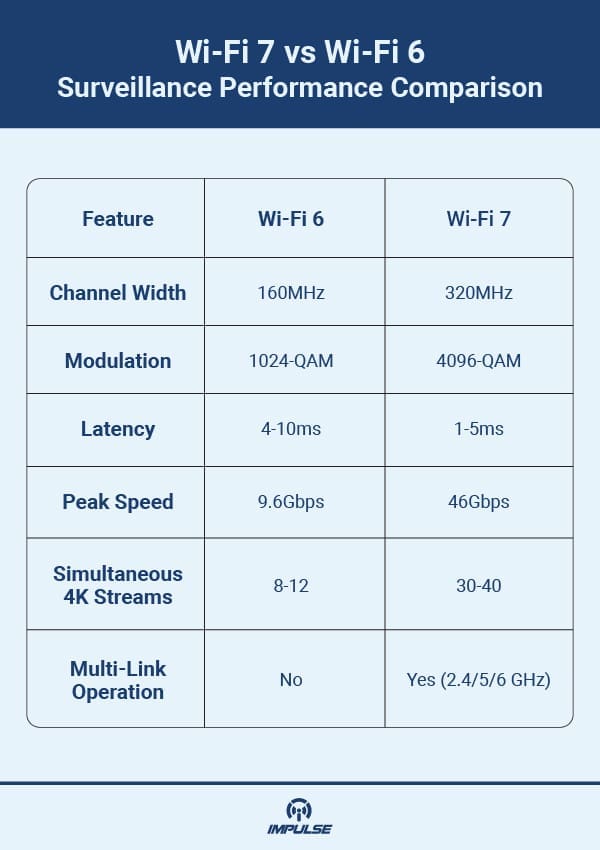
320 MHz Channel Bandwidth: Wi-Fi 7 doubles the maximum channel width from Wi-Fi 6’s 160 MHz to an unprecedented 320 MHz in the 6 GHz band. Think of this as expanding a two-lane highway to four lanes the amount of data that can flow simultaneously increases dramatically. For surveillance systems, this means multiple 4K or 8K camera streams can transmit concurrently without congestion.
4096-QAM Modulation: The new 4096-QAM (Quadrature Amplitude Modulation) scheme increases data density by 20% compared to Wi-Fi 6’s 1024-QAM. Each wireless signal can now carry more information, improving throughput efficiency critical when streaming high-resolution video feeds that demand substantial bandwidth.
Multi-Link Operation (MLO): Perhaps Wi-Fi 7’s most transformative feature, MLO allows devices to simultaneously connect across multiple frequency bands (2.4 GHz, 5 GHz, and 6 GHz). Previous Wi-Fi generations forced devices to choose one band at a time. MLO enables link aggregation for enhanced throughput or seamless band switching for improved reliability and dramatically reduced latency.
Multi-Resource Unit (MRU) Puncturing: This intelligent spectrum management technique allows Wi-Fi 7 devices to “puncture” or skip around interference on specific subcarriers while continuing to use clean portions of the channel. In surveillance environments with multiple wireless devices, this prevents a single source of interference from disrupting entire camera feeds.
The Frequency Spectrum Advantage
Wi-Fi 7 operates across three frequency bands simultaneously:
- 2.4 GHz Band: Offers the longest range and best wall penetration but lower speeds
- 5 GHz Band: Balances range and performance for mainstream applications
- 6 GHz Band: Provides the widest channels (up to 320 MHz) with minimal interference from legacy devices
For surveillance deployments, the 6 GHz band proves particularly valuable. Being relatively new and less congested, it offers cleaner spectrum for interference-free video transmission essential for maintaining consistent video quality in mission-critical security applications.
Why Latency Matters in Security Applications?
In surveillance systems, latency (the time delay between when an event occurs and when it appears on a monitor or triggers an alert) can mean the difference between preventing a security breach and discovering it too late.
Consider these scenarios:
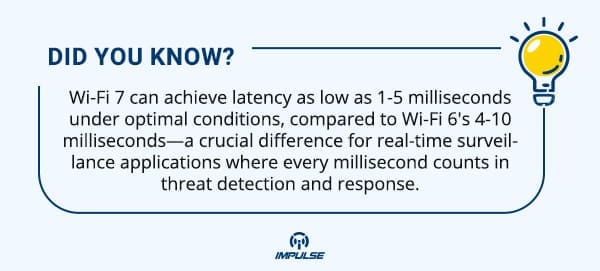
Perimeter Intrusion Detection: When an individual crosses a secure boundary, AI-powered analytics must detect the intrusion, process the video frame, and trigger an alert. With Wi-Fi 6’s typical 4-10 millisecond latency, this process might take several frames, potentially allowing an intruder precious extra seconds. Wi-Fi 7’s sub-5-millisecond latency ensures near-instantaneous detection and response.
Real-Time Facial Recognition: Modern AI-powered video analytics systems process faces in real-time to grant or deny access, identify persons of interest, or track movement patterns. Higher latency introduces lag between when someone approaches a camera and when the system recognizes them, creating awkward delays at access points or, worse, security vulnerabilities.
Live Monitoring During Critical Events: Security personnel monitoring live feeds during emergencies need real-time visibility. Latency-induced delays of even 500 milliseconds can impair decision-making when every second counts. Wi-Fi 7’s deterministic low latency ensures operators see events as they unfold, not seconds afterward.
PTZ Camera Control: When operators need to pan, tilt, or zoom cameras to track a suspect or investigate an incident, control lag is unacceptable. Wi-Fi 7’s reduced latency provides responsive camera control comparable to wired connections.
How Wi-Fi 7 Achieves Ultra-Low Latency
Several technical innovations work in concert to minimize latency:
Multi-Link Operation (MLO) with Simultaneous Transmission: Rather than waiting for one frequency band to become available, MLO allows cameras to transmit video packets across multiple bands simultaneously. If one band experiences congestion, data flows uninterrupted through alternative paths. This redundancy and load balancing dramatically reduces packet transmission delays.
Time-Sensitive Networking (TSN) Support: Wi-Fi 7 incorporates TSN capabilities derived from industrial Ethernet standards. TSN provides deterministic latency by scheduling time slots for critical traffic. Surveillance video streams can be prioritized, ensuring they receive guaranteed transmission windows without competing with lower-priority network traffic.
Improved OFDMA Efficiency: Orthogonal Frequency Division Multiple Access (OFDMA) divides channels into smaller Resource Units (RUs) that can be assigned to individual devices. Wi-Fi 7 enhances OFDMA with up to 264 RUs, allowing more granular channel allocation. Each camera receives dedicated spectrum resources, eliminating contention-based access delays that inflate latency in congested environments.
Reduced Contention Through Enhanced Channel Access: Wi-Fi 7 introduces coordinated scheduling mechanisms that reduce the random access contention inherent in earlier Wi-Fi generations. Instead of cameras competing for channel access and potentially waiting multiple retry attempts, Wi-Fi 7 access points can coordinate transmissions, ensuring smoother, more predictable data flow.
Real-World Benefits for Surveillance Infrastructure
Supporting Multiple High-Resolution Camera Streams
Modern surveillance deployments demand higher resolution cameras to capture critical details license plates, facial features, and small objects at distance. 4K cameras generate approximately 25-50 Mbps per stream, while emerging 8K cameras can require 80-100 Mbps or more.
Consider a medium-sized facility with 30 4K cameras. At 40 Mbps average per camera, the total bandwidth demand reaches 1.2 Gbps exceeding the practical capacity of Wi-Fi 6 networks in real-world conditions where interference, distance, and multiple devices degrade performance.
Wi-Fi 7’s massive throughput capacity easily accommodates such deployments. A single Wi-Fi 7 access point with 320 MHz channels in the 6 GHz band can theoretically support 30-40+ simultaneous 4K streams, providing headroom for future expansion and ensuring consistent performance even during peak network activity.
Wireless Network Design Flexibility
Traditional wired surveillance installations require careful planning around:
- Cable routing through walls, ceilings, and conduits
- Distance limitations (typically 100 meters for standard Ethernet)
- Power over Ethernet (PoE) switch placement and port availability
- Renovation costs when relocating cameras
Wi-Fi 7 liberates security teams from these constraints. Cameras can be repositioned without rewiring, temporary surveillance stations can be deployed for events, and facilities with challenging architecture (historic buildings, outdoor venues, warehouses) become easier to secure.
For organizations with distributed locations, enterprise-grade wireless networks powered by Wi-Fi 7 enable consistent surveillance capabilities across multiple sites without massive infrastructure investments.
Enhanced Reliability and Redundancy
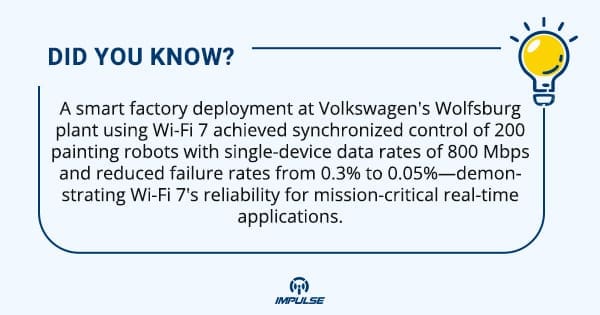
Multi-Link Operation provides inherent redundancy. If one frequency band experiences interference perhaps from a microwave oven on 2.4 GHz or nearby Wi-Fi networks on 5 GHz cameras can maintain connection through the 6 GHz band or switch seamlessly between bands without dropping frames.
This reliability proves invaluable in critical infrastructure, healthcare facilities, financial institutions, and other environments where surveillance uptime is non-negotiable.
Integration with Modern Surveillance Ecosystems
Contemporary surveillance systems extend beyond simple video recording. They integrate with:
- AI analytics platforms for object detection, behavior analysis, and anomaly detection
- Access control systems for credential verification and identity management
- Video management systems (VMS) for centralized monitoring and recording
- Cloud storage for off-site backup and AI-powered search capabilities
All these integrations generate bidirectional data flows that consume bandwidth and demand low latency. Wi-Fi 7’s enhanced capacity ensures these interconnected systems function harmoniously without bottlenecks.
Practical Deployment Considerations
Infrastructure Requirements
While Wi-Fi 7 offers tremendous benefits, successful deployment requires proper planning:
Wi-Fi 7 Compatible Access Points: Organizations need to upgrade to enterprise-grade access points that support Wi-Fi 7 (802.11be) with 320 MHz channel operation in the 6 GHz band. These access points should support features like MLO, 4096-QAM, and TSN for optimal surveillance performance.
Network Backhaul Capacity: While cameras connect wirelessly to access points, those access points require high-capacity wired backhaul to the network core. Deploying Wi-Fi 7 without adequate 10 Gbps Ethernet backhaul or higher creates a bottleneck that negates wireless advantages. Organizations should evaluate their PoE switch infrastructure to ensure sufficient capacity.
Camera Compatibility: Surveillance cameras must include Wi-Fi 7 chipsets to leverage new capabilities. While Wi-Fi 7 maintains backward compatibility with older standards, legacy cameras connect at Wi-Fi 5 or 6 speeds without benefiting from reduced latency or expanded bandwidth.
Site Survey and Channel Planning: Even with Wi-Fi 7’s improved interference mitigation, proper site surveys remain essential. Organizations should map coverage areas, identify interference sources, and strategically plan access point placement and channel assignments to maximize performance and reliability.
Security Considerations
Wireless surveillance introduces security concerns that don’t exist with wired systems:
Encryption: Wi-Fi 7 supports WPA3 encryption, the latest security protocol offering robust protection against unauthorized access and brute-force attacks. All surveillance traffic should utilize WPA3-Enterprise with certificate-based authentication for maximum security.
Network Segmentation: Surveillance cameras should operate on isolated VLANs separate from general business networks. This prevents compromised surveillance devices from becoming lateral movement vectors for attackers and protects sensitive video data from internal network threats.
Physical Security: While eliminating cables reduces some physical attack vectors, wireless access points become critical infrastructure requiring physical protection and tamper-evident installations.
Cost-Benefit Analysis
Wi-Fi 7 deployments involve higher upfront costs than previous wireless generations:
- Enterprise Wi-Fi 7 access points currently command premium pricing
- Camera upgrades to Wi-Fi 7-compatible models require investment
- Network infrastructure upgrades for adequate backhaul capacity
However, these costs must be weighed against:
- Eliminated or reduced cabling expenses: No trenching, conduit installation, or extensive structured cabling
- Installation labor savings: Wireless camera deployment requires less time and specialized expertise
- Flexibility value: Ability to relocate or add cameras without rewiring
- Future-proofing: Wi-Fi 7 infrastructure supports years of surveillance evolution
For new construction, retrofits, or facilities with challenging wired infrastructure, Wi-Fi 7 often delivers superior total cost of ownership despite higher initial investments.
Industry Applications and Use Cases
Corporate Campuses and Enterprise Facilities
Large corporate campuses with multiple buildings, parking structures, and outdoor areas present significant cabling challenges. Wi-Fi 7 enables comprehensive coverage without running cables between buildings or across parking lots. Cameras can monitor entrances, loading docks, and perimeter fencing with minimal infrastructure.
Retail Environments
Retail stores frequently reconfigure layouts, move displays, and adjust security coverage based on seasonal needs or theft patterns. Wireless cameras powered by Wi-Fi 7 provide the flexibility to adapt surveillance coverage as store layouts evolve without costly rewiring projects.
Healthcare Facilities
Hospitals and medical centers require surveillance in sensitive areas like pharmacies, emergency rooms, and equipment storage—but existing structures often make cable installation disruptive or impractical. Wi-Fi 7’s reliability and low latency support high-quality video for safety monitoring, incident documentation, and regulatory compliance.
Transportation Hubs
Airports, train stations, and bus terminals need extensive surveillance across vast, complex structures. Wi-Fi 7 facilitates rapid deployment of cameras in new terminal areas, temporary coverage during construction, and flexible monitoring of transportation platforms, ticketing areas, and baggage handling zones.
Educational Institutions
Schools and universities face unique challenges: aging buildings not designed for modern technology, multiple distributed facilities, and outdoor areas like parking lots and sports fields. Wi-Fi 7 surveillance systems can be deployed without extensive renovation while maintaining the real-time performance necessary for emergency response.
Manufacturing and Industrial Sites
Modern factories require surveillance for safety monitoring, quality control, and asset protection. Wi-Fi 7’s industrial-grade reliability and low latency support AI-powered defect detection systems, worker safety monitoring, and perimeter security across sprawling facilities where cable installation is prohibitively expensive.
The Integration Advantage: Impulse’s Ecosystem Approach
While Wi-Fi 7 provides the wireless foundation, successful surveillance deployments require thoughtfully integrated systems. This is where a complete ecosystem approach delivers maximum value.
Modern surveillance extends beyond standalone cameras. Organizations need:
Intelligent Recording Infrastructure: High-performance Network Video Recorders (NVR) that can handle multiple simultaneous 4K streams, provide redundant storage, and support advanced search capabilities. These systems must keep pace with Wi-Fi 7’s bandwidth capabilities without becoming bottlenecks.
Centralized Management: Comprehensive Video Management Systems that provide unified monitoring across dozens or hundreds of cameras, intelligent event management, and integration with access control and alarm systems. VMS platforms must leverage Wi-Fi 7’s low latency to provide genuinely real-time monitoring experiences.
Scalable Network Infrastructure: The wireless access points are just one component. Organizations need robust PoE switching infrastructure to backhaul wireless traffic, provide power to access points, and connect directly-wired cameras in areas where wireless isn’t ideal. Scalability becomes critical as surveillance systems grow.
Analytics and Intelligence: Modern surveillance creates enormous value through AI-powered video analytics detecting unusual behavior, counting people, identifying vehicles, and generating business intelligence beyond security. These analytics engines must receive low-latency video streams to function effectively, making Wi-Fi 7’s capabilities essential.
Access Control Integration: Surveillance systems work best when integrated with physical access control verifying that credential-based access grants align with visual verification, investigating access-denied events, and providing forensic video evidence for security incidents.
By deploying an integrated surveillance ecosystem rather than disparate components, organizations maximize their Wi-Fi 7 investment. The low latency and high bandwidth become force multipliers when every system component is optimized to work in concert.
Looking Forward: The Wireless Surveillance Future
Wi-Fi 7 represents more than incremental improvement it marks the point where wireless surveillance truly rivals wired systems in performance while vastly exceeding them in flexibility and deployment economics.
As the technology matures over the next 2-3 years, we’ll see:
Declining Hardware Costs: Wi-Fi 7 chipsets and access points will become more affordable as production volumes increase and competition intensifies, making the technology accessible to mid-market organizations.
Camera Innovation: Manufacturers will increasingly embed Wi-Fi 7 capabilities in surveillance cameras as standard equipment rather than premium features, expanding wireless options across product lines.
Hybrid Architectures: Most deployments will adopt hybrid approaches wired connections for fixed, high-traffic locations like lobby entrances, and wireless for difficult-to-reach areas, temporary installations, and flexible coverage zones.
Enhanced AI Integration: As edge AI processing becomes more powerful, cameras will perform more analytics locally, but they’ll still require Wi-Fi 7’s low latency and bandwidth to transmit processed results, alerts, and selected video clips to central systems for coordinated response and long-term analysis.
5G and Wi-Fi 7 Convergence: Some organizations will deploy private 5G for outdoor mobile surveillance while using Wi-Fi 7 for indoor installations, creating unified wireless surveillance networks that leverage the strengths of each technology.
The future of surveillance is unquestionably wireless and Wi-Fi 7 provides the technical foundation to make that future a present reality.
Conclusion
The surveillance industry’s evolution toward wireless systems represents one of the most significant infrastructure transformations in decades. Wi-Fi 7’s ultra-low latency, massive bandwidth capacity, and robust reliability finally make wireless surveillance not just viable but preferable for many applications.
Organizations no longer need to compromise between the flexibility of wireless deployment and the performance of wired infrastructure. Wi-Fi 7 delivers both enabling real-time monitoring with sub-5-millisecond latency, supporting multiple high-resolution camera streams, and providing the redundancy and reliability that mission-critical security applications demand.
However, technology alone doesn’t guarantee success. Effective Wi-Fi 7 surveillance deployments require:
- Careful infrastructure planning and site surveys
- Integration with comprehensive VMS, NVR, and analytics platforms
- Robust network security implementations
- Adequate backhaul capacity to the network core
- Ongoing optimization and monitoring
For security professionals and system integrators, understanding Wi-Fi 7’s capabilities and limitations is essential to making informed deployment decisions. For organizations evaluating surveillance upgrades or new installations, Wi-Fi 7 warrants serious consideration particularly in environments where wired infrastructure is costly, impractical, or inflexible.
The future of surveillance is here, and it’s wireless. Wi-Fi 7 isn’t just faster wireless it’s a fundamentally different approach to building surveillance infrastructure that’s more flexible, scalable, and capable than what came before.
As we stand at this technological inflection point, one thing is clear: the organizations that embrace Wi-Fi 7 and architect their surveillance systems to leverage its capabilities will gain significant operational advantages in security, flexibility, and cost efficiency.
The wireless revolution in surveillance has arrived. The question isn’t whether to participate it’s how quickly your organization can adapt to capture the benefits.