


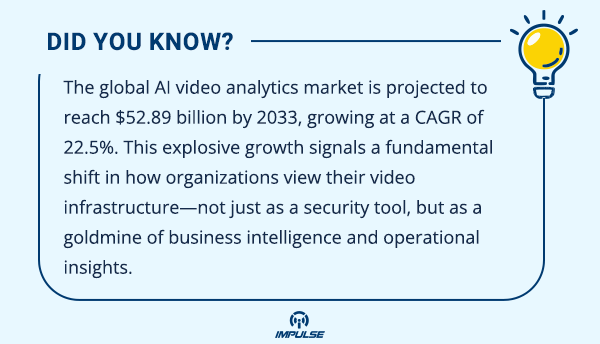
For decades, video surveillance systems served a single purpose: security. Cameras monitored perimeters, recorded incidents, and provided evidence when needed. However, the integration of artificial intelligence and machine learning has revolutionized this paradigm. Today’s intelligent video analytics platforms transform raw video data into actionable business intelligence, driving decisions across operations, customer experience, workforce optimization, and revenue generation.
Organizations are discovering that their existing video infrastructure holds untapped potential. By leveraging AI-powered video analytics, businesses can extract insights that were previously invisible understanding customer behavior, optimizing space utilization, predicting equipment failures, and enhancing operational efficiency. This isn’t just about seeing more; it’s about understanding what you’re seeing and using that understanding to make smarter business decisions.
The Evolution of Video Analytics: From Surveillance to Strategic Asset
Traditional video surveillance systems operated reactively. Security personnel would review footage after incidents occurred, searching through hours of recordings to find relevant moments. This approach was time-consuming, resource-intensive, and limited in scope.
Modern AI video analytics represents a paradigm shift. These systems analyze video streams in real-time, applying sophisticated algorithms to detect, classify, and track objects, people, and behaviors. Rather than simply recording what happens, they understand context, identify patterns, and generate insights automatically.
The transformation involves several key technological advances:
Deep Learning Neural Networks enable systems to recognize complex patterns and behaviors. These networks can distinguish between different types of vehicles, identify specific individuals through facial recognition, and understand unusual activities that might indicate problems or opportunities.
Edge Computing Architecture processes analytics directly on camera hardware or local servers, reducing bandwidth requirements and enabling faster response times. This distributed intelligence approach makes real-time insights possible even across large-scale deployments.
Multi-Modal Data Integration combines video analytics with other data sources IoT sensors, point-of-sale systems, environmental monitoring creating a comprehensive operational picture that drives more informed decision-making.
Business Intelligence Applications Beyond Security
Customer Behavior Analytics and Experience Optimization
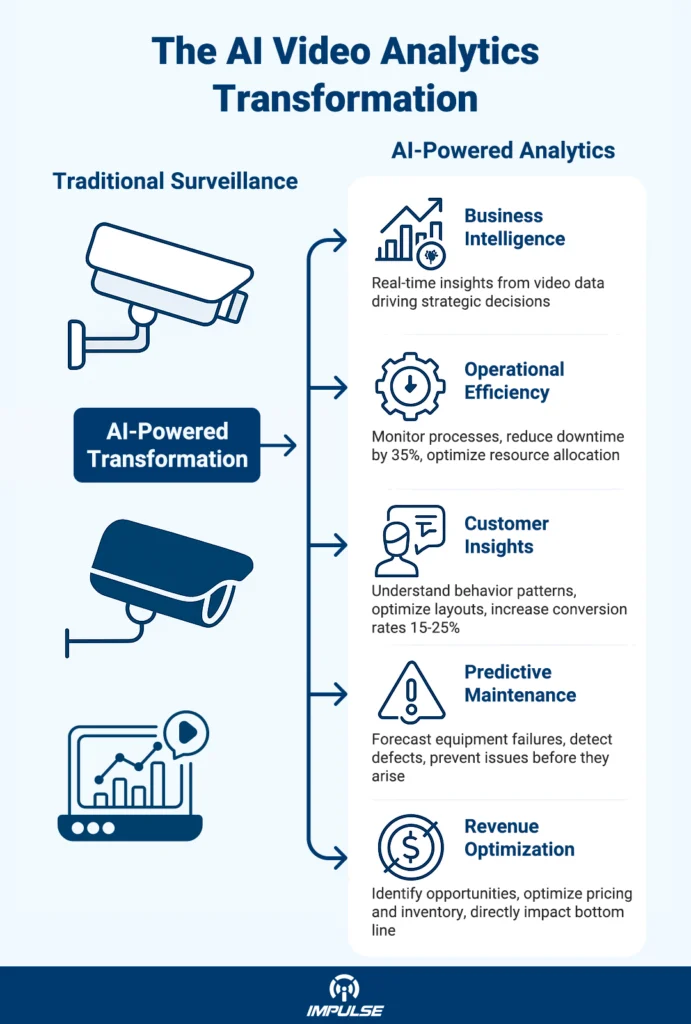
Retailers are leveraging video analytics to understand shopping patterns, dwell times, and customer journeys through their stores. By analyzing how customers navigate spaces, which displays attract attention, and where bottlenecks occur, businesses can optimize layouts and staffing.
Heat mapping technology reveals high-traffic areas and dead zones within retail environments. This data informs decisions about product placement, promotional displays, and store design modifications that directly impact sales conversion rates.
Queue management systems monitor wait times and customer flow, enabling dynamic staff allocation. When analytics detect growing queues, managers receive alerts and can deploy additional personnel to service counters, reducing customer frustration and abandoned purchases.
Operational Efficiency and Resource Optimization
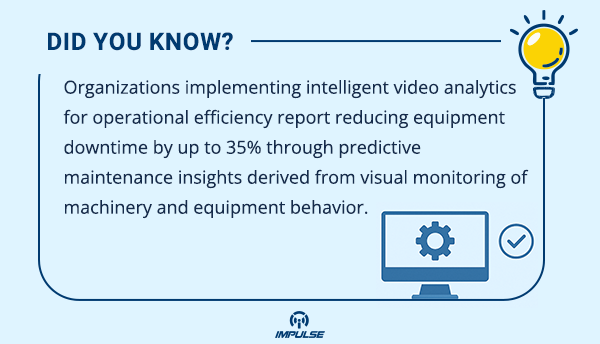
Manufacturing facilities use AI video analytics to monitor production lines, identifying inefficiencies and potential quality issues before they escalate. Computer vision systems can detect product defects with greater accuracy than human inspection, reducing waste and ensuring consistent quality standards.
Space utilization analytics help organizations optimize their real estate footprint. By understanding how conference rooms, workspaces, and common areas are actually used, facilities managers can reconfigure layouts, adjust capacity, and reduce operational costs while improving employee experience.
Energy management integrates with video analytics to control lighting, HVAC, and other systems based on actual occupancy rather than schedules. This intelligent automation reduces utility costs while maintaining comfortable environments for occupants.
Workforce Management and Safety Compliance
Video analytics enhances workplace safety by monitoring compliance with safety protocols. Systems can detect when workers enter restricted areas without proper protective equipment, when safety procedures aren’t being followed, or when dangerous conditions develop.
Time and attendance tracking becomes more accurate and less intrusive. Rather than requiring manual check-ins, analytics systems can automatically track employee presence and movement patterns, providing data for payroll and productivity analysis while respecting privacy boundaries.
Training effectiveness can be evaluated through behavioral analysis. By comparing the movements and techniques of experienced workers with those in training, organizations can identify areas where additional instruction is needed and recognize when employees have achieved proficiency.
Integration with Enterprise Video Management Systems
The power of AI video analytics multiplies when integrated with comprehensive video management platforms. A robust Video Management System serves as the foundation, coordinating cameras, storage, analytics engines, and user interfaces into a unified ecosystem.
IMPULSE XTRA exemplifies this enterprise-grade approach, delivering a user-friendly interface that prioritizes operational efficiency. With the ability to manage four times more cameras per server compared to traditional systems, it provides the scalability essential for growing analytics deployments. The platform’s intelligent modules seamlessly integrate various analytics capabilities—from facial recognition and people counting to behavior analysis and object detection.
Mobile clients extend analytics insights beyond the control room, enabling managers and decision-makers to access real-time data and alerts wherever they are. This accessibility transforms video intelligence from a centralized monitoring function into a distributed business intelligence tool accessible across the organization.
Hardware Infrastructure for Advanced Analytics
Implementing sophisticated video analytics requires robust hardware infrastructure capable of handling the computational demands of AI processing. Network video recorders with advanced specifications provide the foundation for analytics-heavy deployments.
The IMPULSE LX NVR 4-Bay and IMPULSE LX NVR 8-Bay models support up to 4K high-resolution video with H.265 compression, enabling crystal-clear analytics even in challenging conditions. With 320 Mbps bandwidth and support for up to 32 IP channels, these systems handle multiple concurrent analytics streams without compromising performance. The difference lies in storage capacity supporting either 4 or 8 SATA hard drives allowing organizations to scale retention periods based on compliance requirements and analytical needs.
For deployments requiring dedicated analytics processing, specialized hardware like the IMPULSE AI Box 16CH delivers focused computational power. This ARM-based architecture consumes minimal power (≤30W) while supporting facial recognition, passenger flow analysis, full target structuring, and intelligent video analysis across up to 16 channels simultaneously. Its API interfaces enable seamless integration with third-party platforms, making it ideal for custom analytics implementations.
Implementing Analytics-Driven Decision Making
Defining Business Objectives and Use Cases
Successful video analytics implementations begin with clear business objectives. Rather than deploying technology for its own sake, organizations should identify specific challenges or opportunities that analytics can address.
Retail businesses might prioritize understanding customer flow patterns to optimize staffing and merchandising. Manufacturing operations may focus on quality control and predictive maintenance. Healthcare facilities could emphasize safety compliance and patient flow optimization. Each use case requires different analytics capabilities and performance metrics.
Stakeholder alignment ensures that analytics implementations deliver measurable business value. IT teams, operations managers, and business leaders must collaborate to define success criteria, establish baselines, and agree on how insights will drive decisions.
Data Quality and System Configuration
The accuracy of AI video analytics depends heavily on proper camera placement, configuration, and calibration. Analytics algorithms require clear, well-lit footage with appropriate camera angles to function optimally.
Camera positioning should account for both security requirements and analytics needs. A camera positioned for general surveillance might not provide the angle or resolution necessary for detailed behavior analysis or facial recognition. Lighting conditions significantly impact accuracy, with consistent illumination producing better results than areas with dramatic shadows or varying light levels.
Regular calibration and testing ensure continued accuracy. Environmental changes seasonal lighting variations, physical layout modifications, changing traffic patterns can affect analytics performance. Systematic validation processes identify and address these issues before they compromise data quality.
Privacy Considerations and Ethical Implementation
As video analytics capabilities grow more sophisticated, privacy concerns become increasingly important. Organizations must balance the business benefits of detailed monitoring with respect for individual privacy rights and regulatory compliance.
Transparent policies inform stakeholders about what data is collected, how it’s used, and who has access. Many analytics implementations can achieve business objectives using aggregated, anonymized data rather than personally identifiable information. For example, occupancy counting and traffic flow analysis typically don’t require individual identification.
Regulatory compliance GDPR in Europe, CCPA in California, industry-specific regulations establishes legal frameworks for analytics deployment. Consulting legal counsel during planning ensures implementations meet all applicable requirements and avoid potential liabilities.
Advanced Analytics Capabilities and Emerging Technologies
Predictive Analytics and Anomaly Detection
Moving beyond descriptive analytics (what happened) and diagnostic analytics (why it happened), predictive analytics forecast future outcomes and trends. By establishing baselines of normal activity, AI systems can identify anomalies that might indicate problems or opportunities.
In transportation hubs, predictive analytics forecast crowd densities at different times, enabling proactive staffing and resource allocation. Retail environments predict busy periods based on historical patterns combined with external factors like weather, events, and promotions.
Anomaly detection identifies unusual events automatically, alerting personnel to potential security threats, safety hazards, or operational irregularities. Rather than requiring constant human monitoring, the system functions as an intelligent assistant, filtering thousands of hours of footage to highlight the moments that require attention.
Integration with Business Intelligence Platforms
The true power of AI video analytics emerges when insights integrate with broader business intelligence ecosystems. Connecting analytics data with ERP systems, customer relationship management platforms, and financial reporting tools creates comprehensive operational visibility.
Dashboard visualizations present analytics insights alongside other business metrics, revealing correlations and patterns that might not be apparent when viewing data sources in isolation. For example, connecting foot traffic data with sales data reveals conversion rates and identifies opportunities for improvement.
API-based integrations enable automated workflows triggered by video analytics events. When queue lengths exceed thresholds, staff scheduling systems can automatically page additional personnel. When inventory levels in monitored areas fall below targets, replenishment systems can trigger restocking processes.
Machine Learning and Continuous Improvement
Machine learning algorithms improve over time as they process more data. This continuous learning capability means analytics systems become increasingly accurate and valuable as they operate.
Custom model training allows organizations to adapt generic analytics capabilities to their specific environments and needs. A retail chain might train models to recognize specific product categories, while a manufacturing facility could train systems to detect unique defect patterns in their products.
Feedback loops enable system refinement. When analytics generate false positives or miss relevant events, operators can flag these instances, and the system incorporates this feedback into its learning process, progressively reducing errors and improving performance.
Measuring ROI and Business Impact
Quantifiable Metrics and Performance Indicators
Demonstrating the value of video analytics investments requires establishing clear metrics and tracking performance over time. Different applications generate different types of measurable impact.
Operational efficiency gains might be measured through reduced labor costs, improved throughput, or decreased waste. Customer experience improvements could manifest as increased sales conversion rates, higher customer satisfaction scores, or improved loyalty metrics. Safety enhancements reduce incident rates, workers’ compensation claims, and regulatory violations.
Baseline measurements captured before analytics implementation provide comparison points for demonstrating improvement. Regular reporting cycles track progress and identify areas where additional optimization could generate further value.
Long-Term Strategic Benefits
Beyond immediate operational improvements, intelligent video analytics provides strategic advantages that compound over time. The data collected creates historical baselines enabling year-over-year comparisons and long-term trend analysis.
Competitive differentiation emerges as organizations make faster, better-informed decisions than competitors still relying on intuition and limited data. In customer-facing industries, analytics-driven insights into preferences and behaviors enable more personalized experiences and targeted marketing.
Organizational agility increases as real-time insights enable rapid response to changing conditions. Rather than waiting for end-of-month reports to reveal problems, managers can identify and address issues as they develop, minimizing negative impacts and capitalizing on opportunities more effectively.
Future Trends in AI Video Analytics
The video analytics landscape continues evolving rapidly. Emerging technologies and methodologies promise even greater capabilities and business value.
Large language models are beginning to integrate with video analytics, enabling natural language queries and automated report generation. Rather than navigating dashboards and configuring complex searches, users can simply ask questions in plain English and receive relevant insights extracted from video data.
Computer vision advances enable more nuanced understanding of context and intent. Next-generation systems won’t just detect that a person is present; they’ll understand what that person is doing, predict what they might do next, and recognize when behaviors deviate from expected patterns.
Edge AI processing continues improving, enabling more sophisticated analytics at the camera level without requiring powerful centralized servers. This distributed intelligence approach reduces bandwidth requirements, improves response times, and enables analytics deployment in locations where connectivity limitations might otherwise prohibit implementation.
Conclusion
AI video analytics represents far more than an evolution of traditional surveillance technology. It’s a fundamental reimagining of video infrastructure as a strategic business intelligence asset, capable of driving decisions, optimizing operations, and generating measurable value across virtually every aspect of organizational performance.
The organizations thriving in today’s competitive landscape are those recognizing that their cameras see more than security threats they observe customer behaviors, operational patterns, efficiency opportunities, and revenue-generating insights hidden in plain sight. The transition from reactive security monitoring to proactive business intelligence isn’t just technologically possible; it’s becoming competitively essential.
Success requires more than implementing advanced technology. It demands clear business objectives, stakeholder alignment, appropriate infrastructure, and commitment to continuous improvement. When properly planned and executed, video analytics deployments deliver returns that extend far beyond their initial investment, creating ongoing value through better decisions, optimized operations, and deeper understanding of the factors driving business performance.
The future belongs to organizations that see their video systems not as passive recording devices, but as active participants in business intelligence constantly observing, learning, and generating insights that drive competitive advantage. The technology exists. The question isn’t whether to embrace AI-powered video analytics, but how quickly you can begin extracting value from the infrastructure already in place.