

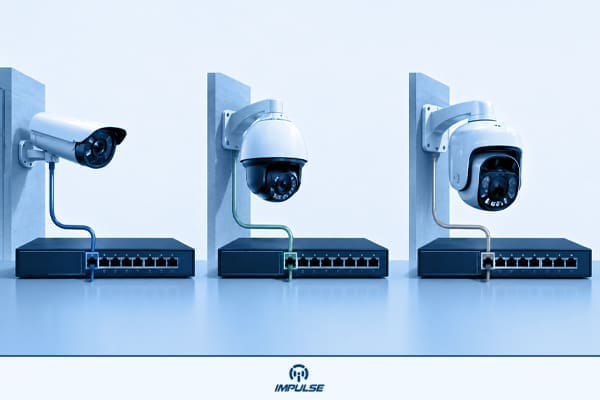
Deploying an IP camera system is more than mounting hardware and running cables. One of the most critical decisions that installers and system designers face and one that often gets underestimated is selecting the right Power over Ethernet (PoE) switch standard. Get it wrong, and your cameras may underperform, fail to boot, or require costly rework.
PoE, PoE+, and PoE++ are not interchangeable. Each standard is built around a specific IEEE specification, delivers a distinct power budget per port, and is suited to a different class of IP camera. Whether you are deploying a small indoor fixed-lens setup or a multi-site network with high-power PTZ units, matching the switch standard to the camera’s power draw is non-negotiable.
This guide breaks down the technical differences between all three standards, maps them to real-world camera use cases, and gives you a structured decision framework for selecting the right switch the first time.

What Is Power over Ethernet (PoE)?
Power over Ethernet is a technology that allows a single CAT5e or CAT6 Ethernet cable to carry both data and DC electrical power simultaneously. This eliminates the need for a separate power adapter or nearby electrical outlet at the camera installation point simplifying deployment, reducing cable clutter, and allowing cameras to be placed in locations where AC power is simply not available.
The technology works through two component types: the PSE (Power Sourcing Equipment) typically the PoE switch or injector and the PD (Powered Device), which is the IP camera. The PSE injects power into the cable; the PD negotiates and draws what it needs through Power Data Object (PDO) signalling.
The three primary standards — governed by IEEE specifications — determine how much power each port can supply.
PoE Standards Explained: IEEE 802.3af, 802.3at, and 802.3bt
Standard PoE — IEEE 802.3af
The original PoE standard delivers a maximum of 15.4W per port at the switch, with approximately 12.95W usable at the device after accounting for cable resistance losses.
This power budget is sufficient for entry-level and low-power IP cameras that do not feature IR illumination arrays, motorised optics, or onboard video analytics processing. Basic fixed-lens indoor dome cameras, VoIP phones, and simple wireless access points typically fall within this range.
Best suited for: Fixed indoor cameras, basic sensors, low-power edge devices.
PoE+ — IEEE 802.3at
PoE+ doubles the per-port output to a maximum of 30W, with approximately 25W delivered reliably to the device. This is the workhorse standard for most modern professional IP camera deployments.
Cameras with wide dynamic range (WDR) processing, long-range IR illumination, built-in microphones, onboard SD card recording, and multi-stream encoding typically require the additional headroom that PoE+ provides. Fixed network dome cameras with extended IR ranges those covering 40 to 60 metres and cameras running quad-stream or edge analytics processes draw power that exceeds what standard PoE can safely supply.
A 5MP fixed dome with 60-metre IR, a built-in microphone, SD card support, and quad-stream capability is a strong example of a device best matched to a PoE+ switch port. The Impulse 5MP fixed dome (60m IR) falls squarely into this category with its 1/2.7″ CMOS sensor, edge analytics, and 60-metre IR, it demands reliable power delivery that only PoE+ can guarantee at scale.
PoE+ is also backward compatible with standard PoE (802.3af) devices, making it a sensible baseline for mixed deployments.
Best suited for: Advanced fixed cameras, cameras with long-range IR, WDR-enabled units, multi-stream devices with onboard analytics.
PoE++ — IEEE 802.3bt
PoE++ is the highest-output commercial standard and comes in two variants:
Type 3 delivers up to 60W per port (approximately 51W at the device). Type 4 delivers up to 100W per port (approximately 71.3W guaranteed at the device).
This level of power delivery is necessary for devices that combine mechanical movement, optical zoom systems, and high-performance IR specifically PTZ (Pan-Tilt-Zoom) cameras. A PTZ unit with 30x optical zoom, motorised pan-tilt mechanisms, privacy masking, IR up to 200 metres, and alarm I/O simply cannot run reliably on PoE or PoE+ power budgets.
The Impulse 5MP PTZ (30x zoom, 200m IR) is a clear example of a PoE++ candidate its 30x optical zoom, 200-metre IR range, IR dimming function adjustable by zoom level, and integrated smart features place its power requirements firmly in the PoE++ range. Pairing it with a lower-standard switch will result in degraded zoom function, IR failure at distance, or thermal shutdowns under sustained use.
Best suited for: PTZ cameras, high-zoom optical systems, high-power IR devices, cameras with motorised mechanics.

Cable Requirements and Power Budget Planning
Selecting the right switch standard is only half the equation. The physical cable infrastructure determines whether the specified power actually reaches the camera.
Cat5e cable is adequate for both PoE (802.3af) and PoE+ (802.3at) deployments at standard run lengths. For PoE++ applications, particularly at longer cable runs or in bundled cable trays, Cat6 or Cat6a is strongly recommended. Copper resistance in Cat5e at 100 metres can cause power loss of 20–30% under PoE++ loads, resulting in voltage drop that prevents reliable device operation.
Power Budget Calculation — A Practical Example:
Consider a 24-port PoE+ switch with a 370W total power budget:
- 16 cameras at 15W each = 240W
- 4 wireless access points at 25W each = 100W
- Total draw: 340W — 92% of available budget
This is tight. Any additional powered device or power spike will push the switch into power-limiting mode, causing cameras to shut down or under-perform. The correct approach here is to upsize to a 740W budget switch, or reduce the number of connected devices per switch.
Always calculate total port power draw against the switch’s stated power budget not just the per-port rating.
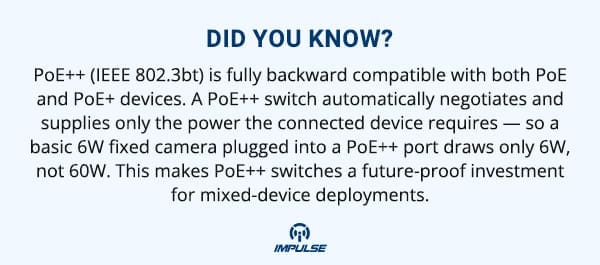
How to Choose the Right PoE Switch: A Decision Framework
The selection process should follow a structured sequence:
Step 1 — Check the camera’s power specification. Every IP camera datasheet lists its power consumption in watts under the “Power Requirements” section. This is the baseline figure.
Step 2 — Add overhead for environmental conditions. In cold environments, IR illuminators draw more power at startup. Factor in at least 10–15% overhead above the rated consumption figure.
Step 3 — Match the switch standard to the highest-power device in the deployment. If any single camera requires PoE+, the ports serving those cameras must be PoE+. If any camera requires PoE++, those specific ports must be PoE++.
Step 4 — Calculate the total power budget across all ports. Sum the power draw of every connected device. The switch’s total power budget must exceed this figure comfortably target no more than 80% utilisation for stable long-term operation.
Step 5 — Plan for future expansion. If the installation will scale adding cameras, NVRs with PoE uplinks, or access control devices choose a switch standard that accommodates the anticipated growth. Upgrading the switch later is costly and disruptive.
NVR Integration: Closing the Power Loop
The switch does not operate in isolation. The Network Video Recorder is the destination for all camera streams, and its bandwidth and resolution capabilities must match the camera ecosystem being powered.
A deployment running advanced PoE+ or PoE++ cameras devices capable of 4K or 5MP resolution at high frame rates with multi-stream encoding requires an NVR that can handle the aggregate recording bandwidth without bottlenecking. For installations of this scale, the Impulse 64-channel 4K NVR supports 64 channels with a recording bandwidth of 640 Mbps, H.265 compression, 8 SATA bays, and 4K preview and playback. Matching your switch standard to cameras and your cameras to an NVR of this calibre ensures the entire system performs as specified from edge to storage.
Common Mistakes to Avoid
Matching per-port wattage without checking total switch budget. A 24-port PoE+ switch may show 30W per port, but if its total power budget is only 185W, it cannot power all 24 ports simultaneously at full draw.
Using Cat5e for PoE++ at long distances. Cable resistance over long runs causes voltage drop that can prevent PoE++ devices from receiving adequate power. Upgrade the cable, not just the switch.
Assuming all PoE switches are the same. Unmanaged PoE switches lack per-port power monitoring and SNMP control. For professional IP camera deployments, a managed PoE switch allows real-time power visibility, port scheduling, and remote power cycling critical for troubleshooting at scale.
Ignoring the camera datasheet. The power requirement of a camera is non-negotiable. It is the first figure to check, not the last.
Conclusion
Choosing between PoE, PoE+, and PoE++ is a technical decision that directly impacts camera performance, system reliability, and long-term scalability. Standard PoE serves low-power fixed cameras; PoE+ is the right choice for advanced fixed units with WDR, extended IR, and multi-stream capability; PoE++ is mandatory for PTZ cameras and any device with motorised mechanics or extreme IR reach.
The correct process is always specification-first: read the camera datasheet, calculate the deployment’s total power draw, plan a buffer, and select the switch accordingly. Pair that decision with appropriately rated cabling and an NVR that can handle the bandwidth, and the system will perform exactly as designed.
Getting the infrastructure layer right from the start is what separates a professional installation from one that requires rework six months later.