

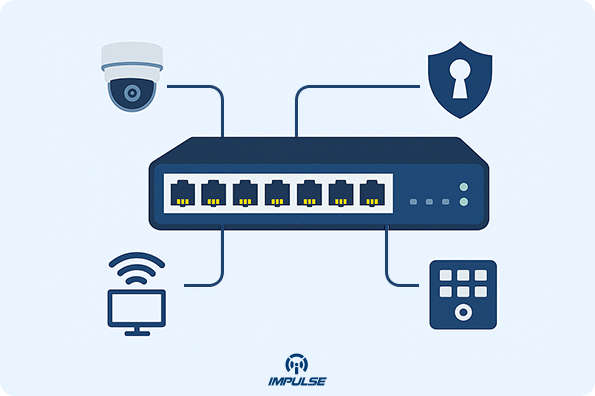
In today’s security landscape, efficiency and reliability are non-negotiable. As organizations deploy surveillance systems across large premises or multi-site infrastructures, managing power, data, and connectivity for hundreds of cameras can become complex. Here’s where PoE Switches revolutionize the process.
For system integrators and security engineers working with enterprise-grade brands like Impulse, understanding the technical role of PoE switches is essential. In this detailed blog, we’ll explore how they form the backbone of modern network security, how they streamline surveillance installations, and how integrating them with systems like the IMPULSE XTRA Video Management System and Network Video Recorder delivers unmatched efficiency and scalability.
In large security environments airports, hospitals, data centers, or smart campuses deploying cameras, sensors, and control devices requires a seamless power and network strategy. Conventional cabling architectures often involve separate electrical circuits and Ethernet runs, making installation time-consuming and fault-prone.
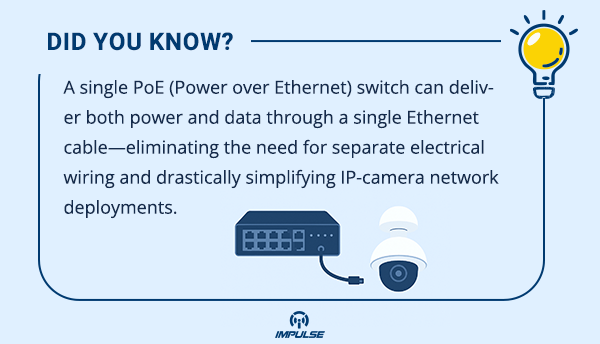
Power over Ethernet (PoE) switches solve this by combining power and data transmission into one network cable. As a result, cameras, access control readers, or wireless APs can all be powered and networked from a central switch no wall sockets, no extra cabling.
This not only simplifies the physical infrastructure but also provides system administrators with real-time control, monitoring, and fault management all from a central interface.
What Is a PoE Switch?
A PoE Switch is a network switch that transmits power and data over the same Ethernet connection. Acting as Power Sourcing Equipment (PSE), the switch provides electric power to Powered Devices (PDs) such as IP cameras, sensors, and VoIP phones.
Modern PoE switches comply with IEEE standards like 802.3af (15.4 W), 802.3at (PoE+, 30 W), and 802.3bt (PoE++, 60-90 W)—each defining the power budget per port. These standards are key when selecting the right switch for high-resolution CCTV cameras, PTZ units, or thermal imaging systems that draw higher wattage.
Core Technical Features:
- PoE Power Budget: Determines how many cameras or powered devices the switch can support simultaneously.
- Gigabit Uplinks: Ensure smooth, lag-free video transmission to servers or NVRs.
- VLAN and QoS Support: Enables traffic prioritization for video feeds and secure segmentation.
- Surge and Temperature Protection: Ideal for industrial or outdoor deployments.
- Remote Reboot and Monitoring: Let engineers reset cameras or analyze port activity remotely.
These attributes make PoE switches indispensable in high-density network security deployments.
How PoE Switches Streamline Security Deployments?
1. Simplified Cabling Architecture
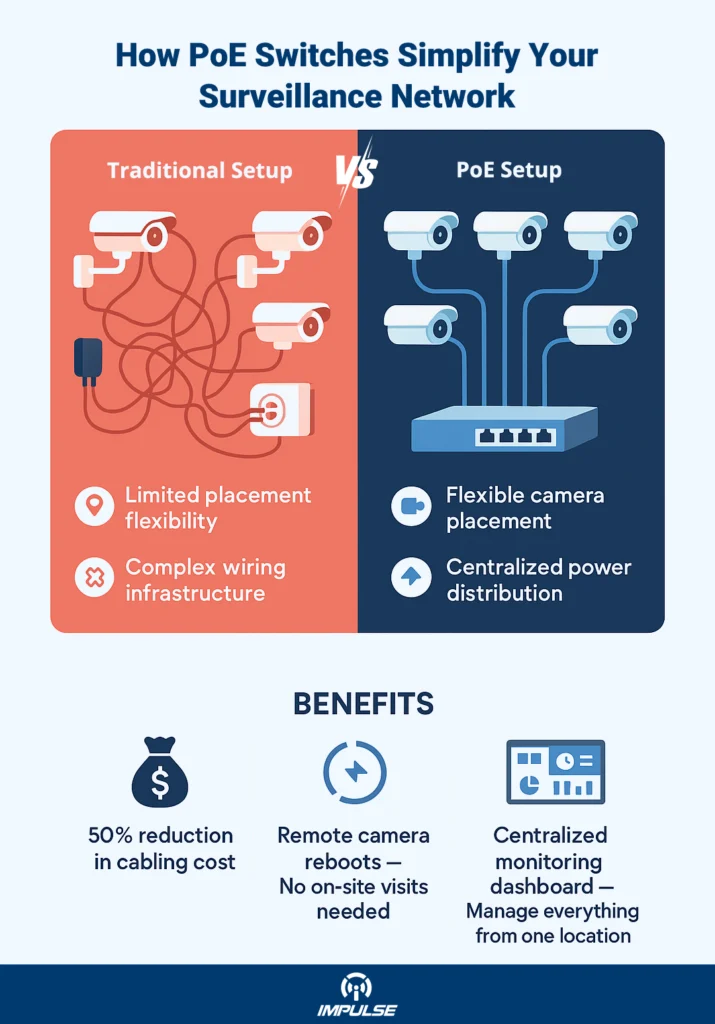
A traditional IP-camera setup requires two connections power and network. With PoE, both run through one cable, eliminating redundant wiring, wall adapters, and external power supplies. This reduces installation time and material cost by up to 50%.
2. Flexible Camera Placement
Cameras no longer need to be near a power outlet. PoE switches allow flexible placement ideal for ceilings, outdoor perimeters, and remote zones. This flexibility gives designers full freedom in optimizing camera coverage without infrastructure constraints.
3. Centralized Management & Control
Using managed PoE switches, administrators can monitor current draw, reset devices remotely, or segment traffic using VLANs. This central management significantly reduces on-site maintenance.
4. Improved Reliability & Reduced Downtime
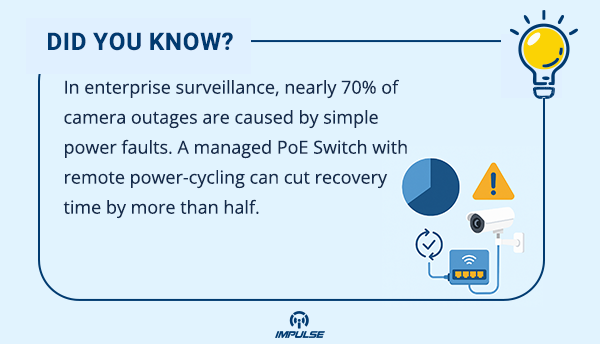
If a camera freezes, the switch can automatically cycle its PoE power effectively rebooting the camera remotely. This minimizes service calls and ensures uninterrupted recording.
5. Lower Power Costs & Greater Efficiency
Since the power delivery is intelligent and controlled, idle ports draw minimal current. Energy-efficient PoE switches contribute to greener, more sustainable surveillance systems.
Technical Design Considerations for Integrators
Designing a security network with PoE switches requires precise planning. The following parameters define system performance and scalability.
A. Power & Port Budgeting
Each connected device draws power from the switch’s overall wattage pool. Integrators must calculate total consumption (number of devices × per-device power) and add a safety margin of 20–30%.
B. Bandwidth Allocation
High-resolution 4K cameras generate significant data. Choose PoE switches with Gigabit uplinks or 10 G SFP fiber ports to prevent congestion.
C. Network Topology
Deploy edge PoE switches close to cameras, then aggregate them into core switches linked to systems like the IMPULSE XTRA Video Management System. This layered design improves redundancy and manageability.
D. Environmental Durability
Outdoor or industrial sites require rugged PoE switches with temperature tolerance and surge protection. Ensure compliance with IP ratings for harsh environments.
E. VLAN Segmentation & Security
Isolate video traffic from the enterprise LAN using VLANs this enhances security, optimizes bandwidth, and ensures surveillance traffic remains unaffected by other IT operations.
Integration with VMS and NVR Systems
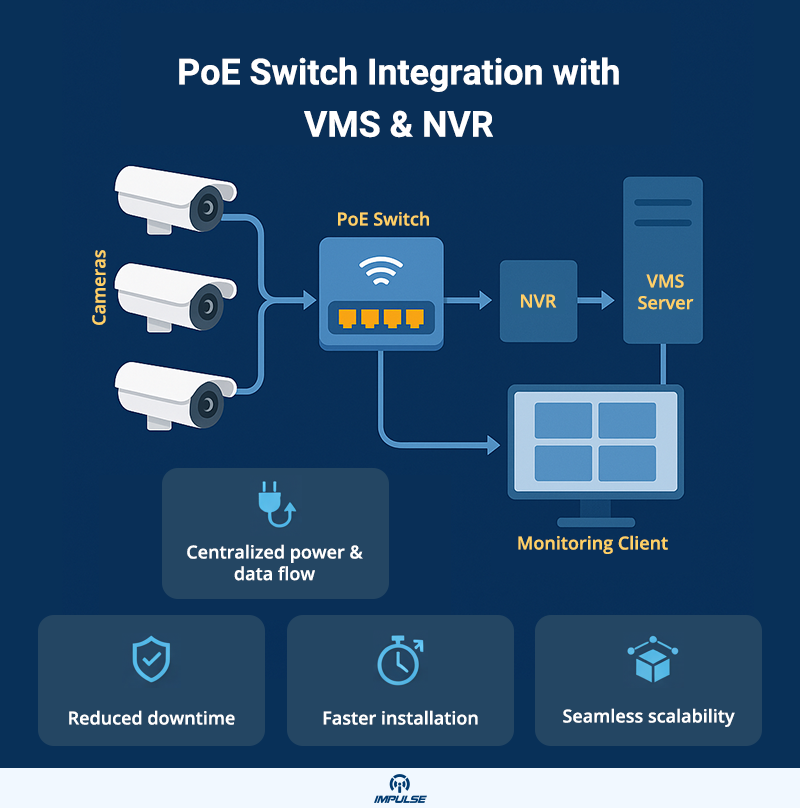
PoE switches don’t just connect cameras they bind the entire security ecosystem together. Integration with management and recording systems ensures real-time monitoring, analytics, and reliability.
a) Integration with Video Management System
The IMPULSE XTRA Video Management System is a robust, enterprise-grade solution built to handle large-scale deployments. With intelligent modules, mobile clients, and flexibility, it offers superior user control.
When paired with a PoE Switch, it ensures:
- Instant device discovery and registration.
- Continuous power delivery to all IP cameras.
- Real-time event alerts when a device goes offline. This synergy enhances operational uptime and optimizes user experience.
b) Integration with Network Video Recorder
The Network Video Recorder from Impulse CCTV supports 4K recording and playback with a high bandwidth capacity of 640 Mbps. To fully utilize its potential, a Gigabit PoE Switch infrastructure ensures smooth data flow from multiple high-resolution cameras without bottlenecks.
When these two systems the VMS and NVR are powered by PoE Switch networks, integrators can deliver unmatched reliability and scalability in their deployments.
Best Practices for PoE Switch Deployment
To ensure optimal performance in network security deployments, follow these professional guidelines:
- Calculate PoE budgets precisely before hardware selection.
- Use CAT6 or higher cabling for better power and data integrity.
- Configure VLANs to isolate camera traffic from IT networks.
- Enable QoS and port prioritization for mission-critical cameras.
- Keep firmware updated to prevent security vulnerabilities.
- Label switch ports and document connections for easy maintenance.
- Use fiber uplinks in large campuses for faster backhaul.
- Reserve power headroom for future expansion.
- Leverage SNMP monitoring for proactive fault detection.
- Perform on-site testing for latency, throughput, and failover before go-live.
Future of PoE in Security Infrastructure
As AI analytics, edge computing, and 4 K/8 K video evolve, so does the demand for higher power and bandwidth. The next-generation 802.3bt PoE standard can deliver up to 90 W per port, allowing one cable to power not just cameras but smart lighting, access controllers, and IoT sensors.
Emerging smart PoE switches integrate device mapping, topology visualization, and AI-based fault prediction making them intelligent nodes in the security infrastructure.
This evolution underscores why PoE Switches are no longer optional they’re foundational to future-ready, integrated security systems.
Conclusion
In a world driven by intelligent surveillance, PoE Switches are the silent enablers that make large-scale security deployments simpler, smarter, and more resilient.
By merging power and data delivery into a single, manageable network layer, PoE switches eliminate wiring complexity, reduce installation costs, and enhance system reliability.
When paired with Impulse CCTV’s cutting-edge solutions like the IMPULSE XTRA Video Management System and Network Video Recorder, integrators can design surveillance networks that deliver maximum uptime, scalability, and operational insight.