

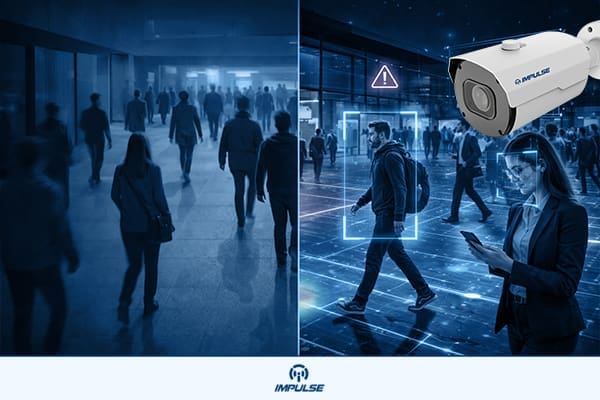
Security has always been a game of reaction. A camera captures something. A guard reviews the footage. A report gets filed. By then, whatever happened is already history.
AI-powered video surveillance is breaking that cycle. Cameras no longer just record they analyze, interpret, and act. The shift from passive recording to active intelligence is rewriting what modern security infrastructure looks like, across retail floors, transit hubs, industrial sites, and urban environments alike.
This blog breaks down exactly how artificial intelligence in security systems works, where it delivers the most value, and what the hardware running it actually needs to do.
What AI Actually Does in a Surveillance System?
A standard camera sees everything and understands nothing. Feed that same footage through an AI video analytics engine, and it starts making sense of the scene tracking objects, classifying behavior, flagging anomalies, and generating structured data from raw video.
At the core of this process is deep learning-based video analysis. Neural networks trained on millions of hours of footage learn to distinguish a person from a shadow, a parked car from an abandoned bag, a normal crowd from a gathering that signals risk.
The processing happens at two levels:
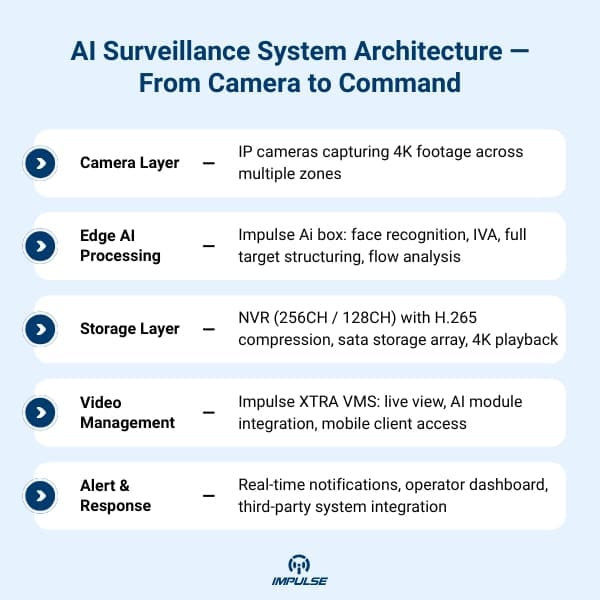
Edge-level inference runs directly on the device or a local AI box attached to cameras. This reduces latency, cuts bandwidth costs, and keeps analysis running even if the network drops.
Server-level analysis aggregates data from multiple cameras, cross-references events, and runs heavier workloads like multi-camera tracking or long-term behavioral pattern analysis.
Both levels rely on one thing: hardware with enough compute to run inference at scale, without burning through power or requiring constant maintenance.
The Six Core Capabilities Reshaping Surveillance
1. Face Recognition at Scale
Facial recognition in CCTV systems has matured well beyond the grainy match-or-no-match logic of early deployments. Modern systems compare live footage against watchlists in under a second, with accuracy rates that hold even under partial occlusion, varying lighting, and different angles.
The use cases are direct: access control, VIP identification, blacklist alerts in retail, and attendance verification in enterprise environments. When running across 16 or more camera channels simultaneously, the compute demand is significant which is why the hardware supporting it matters as much as the algorithm.
2. Full-Target Structuring
Full target structuring means the AI extracts every identifiable attribute from a detected object not just “person detected,” but gender, approximate age, clothing color, bag type, hat, and more. Vehicles get similar treatment: make, color, plate number, direction of travel.
This structured metadata becomes searchable. Instead of scrubbing through hours of footage, operators query the system: “show me everyone in a red jacket who entered Zone B between 2 PM and 4 PM.” The results pull up in seconds.
3. Intelligent Video Analysis and Behavioral Detection
Intelligent video analysis (IVA) covers the behavioral layer what people and objects are doing, not just where they are. Intrusion detection, loitering alerts, perimeter crossing, crowd formation, object removal, and fall detection all fall under this umbrella.
The sophistication gap between rule-based IVA from five years ago and AI-based behavioral analysis today is substantial. Older systems triggered false alarms constantly a tree branch in the wind, a dog crossing a restricted zone. Deep learning models contextualize movement, dramatically reducing false positive rates.
4. Passenger Flow and Occupancy Analytics
Retail chains, airports, and transit authorities are using AI video surveillance for operational intelligence as much as security. Heatmaps of foot traffic, queue length monitoring, occupancy counts, and dwell time analysis all feed into layout decisions, staffing schedules, and compliance with capacity limits.
This is where AI surveillance ROI becomes measurable in operational terms, not just security outcomes.
5. Anomaly Detection Without Predefined Rules
Traditional IVA required operators to draw zones and define rules manually. Deep learning anomaly detection takes a different approach the system learns what “normal” looks like in a given environment and flags deviations, without needing explicit programming for every possible scenario.
This is especially valuable in complex or high-traffic environments where defining every risk scenario in advance is impractical.
6. Real-Time Alerting and Automated Response
The output of all this analysis feeds into alert pipelines. Security personnel get notified immediately — on mobile, on the management console, or through integrated access control and alarm systems. Response time drops from minutes to seconds.
The Hardware Layer: Why Processing Power and Architecture Matter
AI video analytics is compute-intensive. Running face recognition, full target structuring, and behavioral analysis across 16 simultaneous channels requires hardware built for exactly that workload.
This is where dedicated AI inference hardware earns its place in a modern security stack. The AI Box (16-channel) from Impulse is built on an ARM-based embedded architecture specifically for this purpose supporting face recognition, passenger flow analysis, full target structuring, and intelligent video analysis across all 16 channels with a total power draw of under 30W. For deployments where efficiency and flexibility matter edge sites, branch locations, or environments with limited rack space that combination of performance and low power consumption changes what’s practical to deploy.
It supports RTSP protocol docking and third-party API integration, which means it fits into existing infrastructure rather than forcing a full replacement.
Storage and Recording: The Backbone of Any AI Surveillance Deployment
AI video analytics generates structured data, but the video itself still needs to be stored and at 4K resolution across dozens or hundreds of channels, that’s a serious infrastructure requirement.
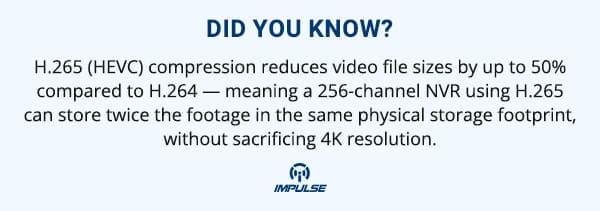
H.265 Network Video Recorders address this directly. H.265 compression delivers the same visual quality as H.264 at roughly half the bitrate, which translates to either longer retention periods or reduced storage hardware costs for the same retention window.
For large-scale deployments, the Impulse SPS NVR (256-channel, 16-bay, 4K) handles 256 channels with 16 SATA bays, 1824 Mbps recording bandwidth, and full 4K resolution for both live preview and playback. Mid-scale sites with up to 128 cameras can use the Impulse SPS NVR (128-channel, 8-bay, 4K), which delivers 640 Mbps bandwidth with 8 SATA bays and the same 4K capability.
Both are built for continuous operation at the bandwidth levels that high-channel AI surveillance demands.
Managing It All: Video Management at Enterprise Scale
Hardware performance only matters if operators can actually use the system effectively. A Video Management System (VMS) is where all the camera feeds, AI alerts, analytics dashboards, and recorded footage come together into a usable interface.
The IMPULSE XTRA VMS is built for exactly this an enterprise-grade platform developed in Canada, designed to run four times more cameras per server compared to standard VMS solutions. It supports intelligent AI modules natively, offers mobile client access, and prioritizes interface simplicity without sacrificing capability. For large security operations managing dozens of sites and hundreds of cameras, that operational efficiency is worth more than most individual hardware upgrades.
Where AI Surveillance Is Being Deployed Right Now?
AI-powered security systems are no longer pilot projects. They’re live infrastructure across multiple sectors:
Retail uses AI video analytics for shrinkage prevention, queue management, and customer behavior analysis. A system that alerts staff when a specific individual enters the store or flags unusual behavior near high-value merchandise changes what theft prevention looks like.
Transportation and logistics uses AI surveillance for perimeter security, vehicle tracking, and access control at entry points. The combination of plate recognition and behavioral anomaly detection covers both vehicular and foot traffic.
Critical infrastructure utilities, data centers, government facilities relies on AI-based intrusion detection and real-time video analytics to protect assets where human monitoring alone is insufficient.
Smart cities deploy AI video surveillance across public transit, intersections, and civic spaces for both security and traffic optimization.
What “AI-Ready” Infrastructure Actually Requires?
Deploying AI video surveillance on infrastructure built for basic recording creates bottlenecks fast. A checklist for any serious deployment includes:
- Dedicated AI inference hardware capable of running multiple analytics workloads simultaneously without frame drops
- High-bandwidth NVR storage matched to channel count and resolution requirements
- H.265 encoding across cameras and recording to manage storage costs at scale
- Open API and protocol support (RTSP, third-party integration) for a unified security stack
- Centralized VMS with AI module support and mobile access for operational control
Each layer depends on the others. Weak storage creates gaps in footage. Underpowered AI hardware means analytics only run on some channels, or at reduced accuracy. A fragmented management interface means alerts get missed.
Conclusion
AI video surveillance is not a feature upgrade bolted onto traditional CCTV. It’s a fundamental shift in what a security system does from recording events to understanding them, from reactive review to proactive response.
The technology is mature. Face recognition, intelligent video analysis, full target structuring, and behavioral anomaly detection are running in production environments across sectors globally. What separates deployments that work from those that underperform is the infrastructure underneath hardware that can handle the compute, storage that can handle the volume, and management software that brings it all into a coherent operational picture.
Security teams that invest in that infrastructure aren’t just upgrading their cameras. They’re building a system that actually keeps up with the threats it’s meant to address.