

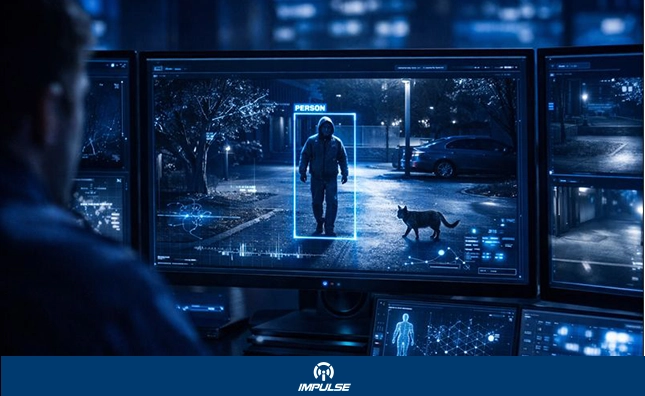
In the evolving landscape of video surveillance technology, one challenge has persistently plagued security operations: the epidemic of false alarms. Security personnel worldwide spend countless hours investigating alerts triggered by swaying branches, passing shadows, or stray animals distractions that divert attention from genuine security threats. The financial and operational costs are staggering, with businesses losing productivity and monitoring centers becoming desensitized to alerts.
Enter AI-powered object recognition a revolutionary approach that’s transforming how we think about intelligent video surveillance. By leveraging machine learning algorithms and computer vision technology, modern surveillance systems can now distinguish between a potential intruder and a neighborhood cat with remarkable precision. This isn’t just an incremental improvement; it’s a paradigm shift that can reduce false alarms by an astonishing 95-99%, fundamentally changing the economics and effectiveness of security monitoring.
Understanding the False Alarm Crisis in Traditional Surveillance
The Hidden Costs of Motion Detection Systems
Traditional CCTV security systems rely on basic motion detection a technology that triggers alerts whenever pixel changes occur within the camera’s field of view. While this approach seems logical on the surface, it creates significant operational challenges:
Environmental Factors: Wind-blown vegetation accounts for approximately 28% of false alarms in outdoor installations. Tree branches, bushes, and even tall grass create constant motion that traditional systems interpret as potential threats.
Lighting Variations: Shadows from passing clouds, vehicle headlights, or changing sunlight angles trigger countless unnecessary alerts. A simple shadow moving across a protected area can generate the same response as an actual intruder.
Animal Activity: Wildlife and domestic pets contribute to 14-25% of false alarms. A dog wandering through a warehouse parking lot or insects near the camera lens can trigger security protocols designed for human intruders.
Weather Conditions: Rain, snow, and fog create visual noise that motion-based systems struggle to filter, resulting in alert storms during inclement weather.
The cumulative effect is overwhelming. Security operations centers receiving thousands of alerts per day face what’s known as “alarm fatigue” a condition where operators become desensitized to warnings, increasing the risk that genuine threats go unnoticed.
The Economic Impact
The financial implications extend beyond wasted staff time. False alarms trigger unnecessary emergency responses, strain relationships with law enforcement, and can result in fines in jurisdictions with false alarm ordinances. More critically, they erode the fundamental value proposition of surveillance systems: providing reliable security intelligence when it matters most.
How AI-Powered Object Recognition Works?
The Technology Behind Intelligent Detection
Artificial intelligence video analytics represents a fundamental departure from simple motion detection. Instead of merely identifying pixel changes, AI-enabled surveillance systems use sophisticated algorithms to understand what they’re seeing. Here’s how the technology stack operates:
1. Computer Vision Foundation
At the core lies computer vision a field of AI that enables computers to derive meaningful information from visual inputs. Modern surveillance systems employ convolutional neural networks (CNNs), a type of deep learning architecture specifically designed for image analysis.
2. Object Classification
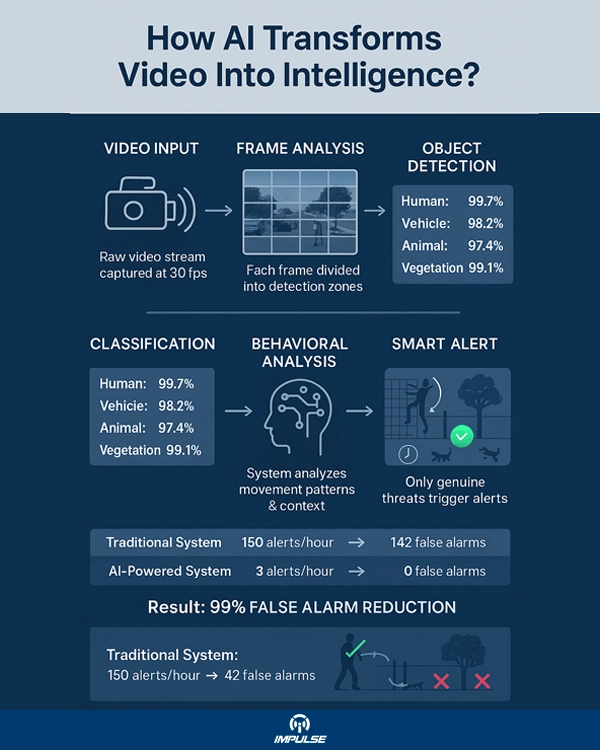
The system analyzes video frames in real-time, identifying and classifying objects into predefined categories:
- Human figures (adults, children)
- Vehicle types (cars, trucks, motorcycles, bicycles)
- Animals (dogs, cats, wildlife)
- Inanimate objects (packages, furniture, vegetation)
3. Behavioral Pattern Analysis
Advanced AI security cameras go beyond simple classification. They analyze movement patterns, detect anomalies, and assess whether detected activity matches threat profiles. The system learns what constitutes “normal” activity in each monitored area and flags deviations that warrant attention.
4. Contextual Intelligence
Modern systems incorporate contextual awareness understanding that a person walking on a sidewalk during business hours requires no alert, while someone scaling a fence at 2 AM demands immediate notification.
The Power of Deep Learning in Surveillance
Training Intelligent Systems
The effectiveness of AI-powered surveillance systems stems from their training on massive datasets. These systems are exposed to millions of labeled images during development, learning to recognize objects under various conditions:
- Different lighting scenarios (daylight, dusk, nighttime, artificial lighting)
- Weather conditions (clear, rainy, foggy, snowy)
- Viewing angles and distances
- Partial occlusions and crowded scenes
This extensive training enables deep learning analytics to achieve recognition accuracy that rivals or exceeds human capabilities while maintaining perfect consistency across 24/7 operation.
Edge Processing vs. Cloud-Based Analytics
Modern intelligent surveillance architecture offers two primary deployment models:
Edge AI Processing: Computation occurs directly on the camera or dedicated edge device. This approach offers several advantages:
- Zero latency analysis happens in real-time without network delays
- Enhanced privacy video doesn’t need to leave the premises
- Reduced bandwidth requirements
- Operation continues even if network connectivity is lost
The AI Box from Impulse exemplifies this approach, delivering powerful edge-based analytics with remarkably low power consumption. Its ARM architecture-based design supports up to 16 channels of simultaneous video analysis while consuming just 30W of power. The system handles multiple AI analytics functions including face recognition, passenger flow analysis, and full target structuring all processed locally for maximum security and responsiveness.
Cloud-Based Processing: Analysis occurs on remote servers, offering different benefits:
- Access to more powerful computational resources
- Easier updates and algorithm improvements
- Centralized management across multiple locations
- Advanced features requiring significant processing power
Many organizations adopt hybrid approaches, using edge processing for immediate threat detection while leveraging cloud capabilities for advanced analytics and long-term pattern analysis.
Real-World Applications and Performance Metrics
Proven False Alarm Reduction
Field deployments demonstrate the transformative impact of AI-powered object recognition:
Recent implementations in retail environments have achieved 90% false alarm reduction, with one national chain decreasing monthly false alarms from over 200 to just 10. Independent research confirms these performance gains, reporting vehicle detection rates of 99.4% with only 1.77% false alarms.
Industrial applications show even more impressive results. Advanced AI video analytics systems utilizing proprietary computer vision algorithms can filter up to 99.95% of false alarms, transforming security operations from reactive alert management to proactive threat prevention.
Practical Implementation Scenarios
Perimeter Security
Organizations protecting large outdoor areas benefit dramatically from AI object detection. The Varifocal Bullet Camera equipped with intelligent analytics can differentiate between authorized personnel, delivery vehicles, and potential intruders across its 50-meter IR range. Its 2.8-12mm varifocal lens provides flexible coverage while the onboard analytics ensure that only relevant detections generate alerts.
Indoor Monitoring
For interior applications, the Varifocal Network Dome Camera delivers discreet yet powerful AI-enhanced surveillance. Its compact form factor houses sophisticated object recognition capabilities that reduce false alarms from HVAC-induced shadows, cleaning staff activities, or decorative plants swaying from ventilation airflow.
Wide-Area Coverage
High-security installations requiring comprehensive monitoring leverage PTZ cameras with integrated AI. The PTZ IP Network Camera combines 40X optical zoom with edge analytics and auto-tracking capabilities. When the system detects a person in a restricted zone, it automatically tracks their movement across the 200-meter IR range while maintaining visual lock ensuring complete documentation without manual operator intervention.

Advanced Features Transforming Security Operations
Facial Recognition Integration
Modern AI surveillance technology extends beyond simple object detection to identify specific individuals. This capability serves multiple purposes:
- Access Control: Automated recognition of authorized personnel
- Watchlist Alerts: Immediate notification when persons of interest appear
- Time and Attendance: Touchless tracking of staff movements
- Enhanced Investigation: Rapid identification of subjects during forensic review
These features integrate seamlessly into comprehensive security ecosystems, providing layers of intelligence beyond traditional surveillance.
Intelligent Content Search
Perhaps one of the most underappreciated benefits of AI-powered video analytics is the transformation of forensic investigation. Traditional systems require operators to manually scrub through hours of footage searching for specific events. AI-tagged video enables instant search queries: “Show me all deliveries between 2-4 PM yesterday” or “Find instances of vehicles parking near the east entrance last week.”
The Video Management System platform from Impulse XTRA leverages these capabilities to provide an enterprise-grade solution with unparalleled search and analysis functionality. Its intelligent modules enable security teams to retrieve precisely the footage they need in seconds rather than hours, transforming post-event investigation from a tedious chore into an efficient process. With a user-friendly interface and the capability to handle four times more cameras for the same server, it represents a comprehensive approach to modern security management.
Implementing AI Object Recognition: Technical Considerations
System Architecture Design
Successful AI surveillance implementation requires thoughtful system design:
1. Camera Selection and Placement
Choose cameras with specifications matching your monitoring requirements. Consider:
- Resolution requirements (2MP-5MP depending on identification distance)
- Lighting conditions (WDR capability, IR range)
- Environmental challenges (weatherproofing, temperature extremes)
- Field of view and focal length needs
2. Processing Infrastructure
Determine whether edge processing, cloud analytics, or hybrid architecture best serves your needs. The AI Box provides excellent edge processing for up to 16 cameras, while maintaining flexibility for cloud integration through its robust API interfaces and support for multiple protocols including RTSP.
3. Network Infrastructure
Ensure adequate bandwidth for IP camera streams while accounting for:
- Peak usage scenarios
- Redundancy requirements
- Quality of Service (QoS) configurations
- Future expansion capacity
4. Integration Requirements
Modern security ecosystems involve multiple systems. Verify that your AI analytics platform supports:
- Multiple protocol support (RTSP, ONVIF)
- VMS integration capabilities
- Access control system connectivity
- Third-party platform APIs
Calibration and Optimization
AI-powered surveillance systems require initial calibration to maximize performance:
Zone Configuration: Define areas of interest where detection should trigger alerts, and exclusion zones where activity should be ignored.
Object Size Parameters: Establish minimum and maximum object sizes to filter out false positives from insects near the lens or distant irrelevant activity.
Sensitivity Tuning: Adjust detection thresholds based on environmental factors and operational requirements.
Schedule-Based Rules: Configure different detection behaviors for various times (stricter parameters during closed hours, relaxed settings during business operations).
Overcoming Implementation Challenges
Addressing Common Concerns
Privacy Considerations
The enhanced capabilities of AI surveillance naturally raise privacy questions. Responsible implementation requires:
- Clear policies on data retention and access
- Transparent communication about monitoring areas
- Compliance with relevant regulations (GDPR, CCPA, local ordinances)
- Appropriate security measures protecting collected data
Algorithm Accuracy
While modern AI object recognition achieves impressive accuracy, no system is perfect. Implementation strategies should include:
- Multi-layer verification for critical security decisions
- Regular accuracy audits and performance monitoring
- Continuous algorithm training with site-specific data
- Human oversight for high-stakes scenarios
Environmental Adaptability
Outdoor installations face changing conditions that can challenge detection accuracy. Mitigation strategies include:
- Seasonal recalibration to account for vegetation growth
- Weather-adaptive sensitivity algorithms
- Multiple overlapping camera coverage for critical areas
- Periodic system performance reviews
The Future of AI-Powered Surveillance
Emerging Capabilities
The evolution of intelligent video surveillance continues accelerating:
Predictive Analytics: Next-generation systems will identify potential security incidents before they occur by analyzing behavioral patterns and anomalies.
Enhanced Integration: Deeper connectivity with building management systems, access control, and emergency response platforms will create truly intelligent security ecosystems.
Advanced Behavioral Analysis: Future algorithms will recognize complex behaviors—identifying distressed individuals, detecting unusual crowd formations, or recognizing abandoned objects with greater sophistication.
Improved Edge Processing: Continued advances in edge computing will bring more powerful analytics capabilities to camera-level processing, reducing latency and enhancing privacy.
Industry Adoption Trends
Organizations across sectors are recognizing the transformative potential of AI video analytics:
- Retail: Reducing shrinkage while gathering customer behavior insights
- Manufacturing: Enhancing workplace safety through hazard detection
- Critical Infrastructure: Protecting utilities, data centers, and transportation hubs
- Healthcare: Securing facilities while monitoring patient safety
- Education: Creating safer campuses with privacy-conscious monitoring
The technology has matured from experimental to mission-critical, with reliability and performance that justify integration into the most demanding security applications.
Conclusion
The transformation from traditional motion detection to AI-powered object recognition represents more than an incremental improvement in surveillance technology it’s a fundamental reimagining of what’s possible in security operations. By reducing false alarms by 95-99%, these systems don’t just save money and resources; they restore the fundamental purpose of surveillance: providing reliable, actionable intelligence when it matters most.
Organizations implementing intelligent video analytics report not just fewer false alarms, but improved overall security postures. Operators can focus attention on genuine threats, investigations become dramatically more efficient, and the total cost of ownership decreases even as capabilities expand.
The technology has reached a maturity level where it’s accessible to organizations of all sizes. Whether you’re protecting a small retail location or managing security across a sprawling industrial complex, AI-enhanced surveillance offers proven benefits that justify the transition from legacy systems.
As deep learning capabilities continue advancing and edge processing becomes more powerful, the gap between AI-powered and traditional surveillance will only widen. The question facing security professionals is no longer whether to adopt these technologies, but how quickly they can be implemented to realize their transformative benefits.