

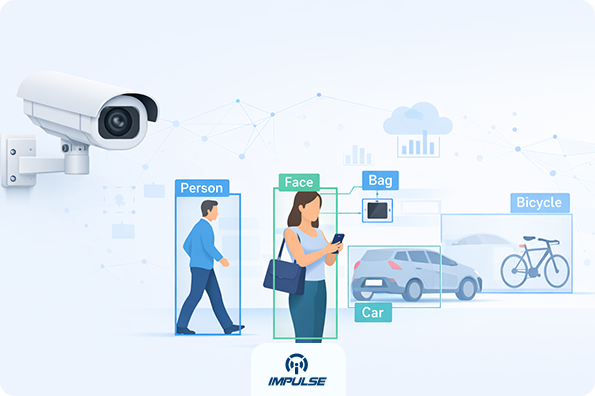
Security cameras have been around for decades. But for most of that time, the footage they captured sat on hard drives waiting for someone to manually review it, often after something had already gone wrong. That reactive model worked well enough when threats were simpler and sites were smaller. It does not hold up anymore.
AI-powered video analytics changes how security infrastructure actually functions. Instead of recording and reviewing, modern systems detect, analyze, and respond in real time. The shift is less about the cameras themselves and more about the intelligence processing what those cameras see. For businesses, campuses, retail environments, and critical infrastructure, this is a meaningful operational upgrade, not just a marketing claim.
This blog breaks down what AI video analytics actually does, how it works within a surveillance system, and what to look for when evaluating whether a setup can genuinely support it.
What AI Video Analytics Actually Does?
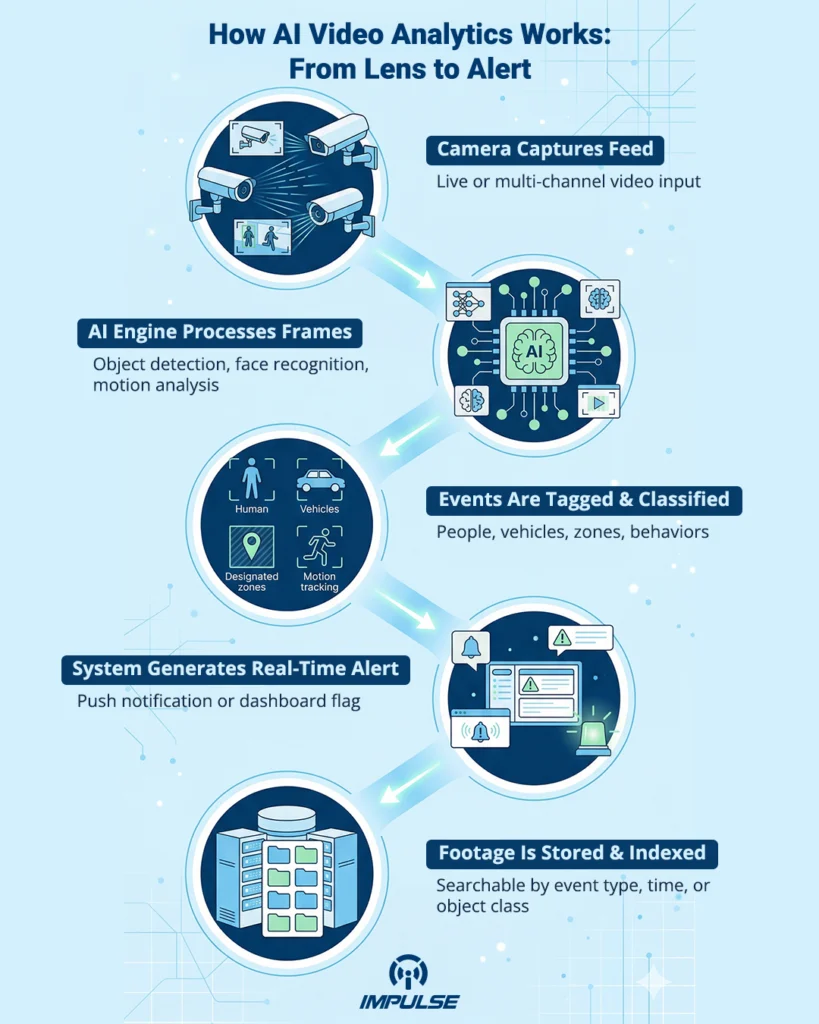
At its core, AI-powered video surveillance applies machine learning algorithms to live or recorded footage to extract structured information automatically. Instead of a person watching a screen, a trained model watches the feed.
What that looks like in practice covers a fairly wide range of functions. Face recognition matches detected faces against a database in real time, relevant for access control and crowd monitoring. Passenger flow analysis tracks movement patterns across a space to identify congestion, unauthorized zone entry, or unusual crowd behavior. Full target structuring means the system can categorize objects, vehicles, people, and events simultaneously within a single frame. Intelligent video analysis pulls all of these functions together into a coherent alert and reporting layer.
None of this requires human eyes on a monitor 24/7. The system flags what matters and logs everything else.
The Hardware Side: Where Processing Actually Happens
One reason AI-based CCTV systems often fall short is that the camera network is set up without accounting for where the analytics computation actually runs. Streaming 16 channels of HD footage to a cloud server for processing introduces latency, bandwidth load, and reliability risks.
Edge-based processing addresses this. When the AI engine runs on-premise, on dedicated hardware close to the cameras, the analysis happens locally. Alerts are faster. Bandwidth requirements drop significantly. The system keeps functioning even if internet connectivity is interrupted.
The Impulse AI Box (16-Channel) is built around this architecture. Based on ARM, the unit draws under 30W for the entire machine while supporting up to 16 channels of AI analysis simultaneously, covering face recognition, passenger flow, full target structuring, and intelligent video analysis. It connects via RTSP protocols and offers API access for third-party platform integration, which matters when a security deployment needs to talk to access control, HR, or building management systems.
For environments where AI video analytics needs to scale without a server room full of hardware, that kind of edge deployment is the practical path.
Storage: The Often-Overlooked Bottleneck
AI analytics generates more data than traditional motion-triggered recording. When a system is classifying objects, logging behavioral events, and maintaining searchable indexes of footage, storage infrastructure becomes a real constraint.
H.265 compression is the current standard for high-density surveillance storage. Compared to H.264, it cuts file sizes roughly in half at equivalent quality, which extends the effective retention window on any given storage array. For sites running multiple high-resolution streams, this difference is operationally significant.
A 64-channel setup recording at 4K resolution with a 640 Mbps bandwidth ceiling needs storage hardware that can actually keep up. The Impulse NVR handles this with 8 SATA bays, 4K preview and playback support, and H.265 recording across all channels. It is the kind of NVR that sits behind an AI analytics deployment without becoming the limiting factor.
Camera Selection for AI-Ready Networks
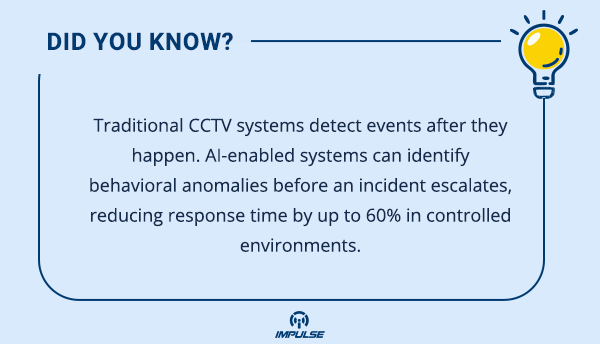
The quality of any AI video analytics output depends directly on the quality of the input. A camera with poor low-light performance, insufficient resolution, or no vandal protection creates gaps in coverage that no software layer can compensate for.
For fixed surveillance positions, cameras with solid environmental ratings and network-level security features are the baseline. The Impulse Dome Camera carries an IK10 vandal-proof rating and supports privacy masking, password protection, IP address filtering, dual-stream output, and heartbeat monitoring, making it a dependable input device for network video systems that need to stay tamper-proof.
For perimeter surveillance, wide-area monitoring, or any scenario requiring dynamic subject tracking, PTZ cameras with long-range IR become necessary. The Impulse PTZ Camera supports 30x optical zoom, 200-meter IR range with adjustable IR dimming tied to zoom position, 4 programmable privacy masks, and smart features including motion detection and alarm I/O. That combination covers the kind of large perimeter or open-space monitoring where AI analytics needs a camera that can actively follow a flagged target rather than just record a fixed field of view.
Key Considerations Before Deploying AI Analytics
Not every site needs every feature listed above. But a few technical checkpoints apply across most deployments.
Processing location matters. Cloud-only analytics introduces latency and dependency on internet uptime. Edge processing keeps the system functional and responsive regardless of connectivity.
Multi-protocol support extends flexibility. A system that only works within a closed ecosystem limits future expansion. RTSP compatibility and open API access let the analytics layer connect with other platforms without a full system replacement.
Storage must be sized for the analytics load. AI events generate more metadata than standard recordings. Factor in not just video file sizes but the database overhead from event logs and structured data.
Camera specs need to match the deployment environment. Indoor fixed cameras, outdoor vandal-proof domes, and long-range PTZ units each serve different roles. An AI system is only as good as the footage it receives.
Conclusion
AI-powered video analytics is not a single product or feature. It is a capability that runs across an entire system, from the cameras that capture footage, to the hardware that processes it, to the storage that retains it, and the interfaces that surface what matters. Getting that stack right requires hardware choices that are designed to work together.
The shift from passive recording to active, intelligent monitoring is not a distant upgrade. The technology is deployable now, at a range of scales, and the operational case for it is straightforward: less time watching footage, faster response to real events, and a security infrastructure that does more than store evidence.