


The surveillance industry is no longer just about recording footage; it has become an intelligent, interconnected security ecosystem. As organizations worldwide face increasingly sophisticated threats, the demand for smarter CCTV and video surveillance technology has never been greater. From AI-powered video analytics and edge computing to 5G-enabled surveillance networks and deep learning-based detection, the next generation of security cameras is redefining what surveillance means for enterprises, smart cities, and critical infrastructure alike.
In this blog, we explore the most transformative trends shaping CCTV technology in 2025 and beyond, covering the technical innovations that security professionals, system integrators, and enterprise decision-makers need to understand to stay ahead of the curve.

1. AI-Powered Analytics and Deep Learning in Surveillance
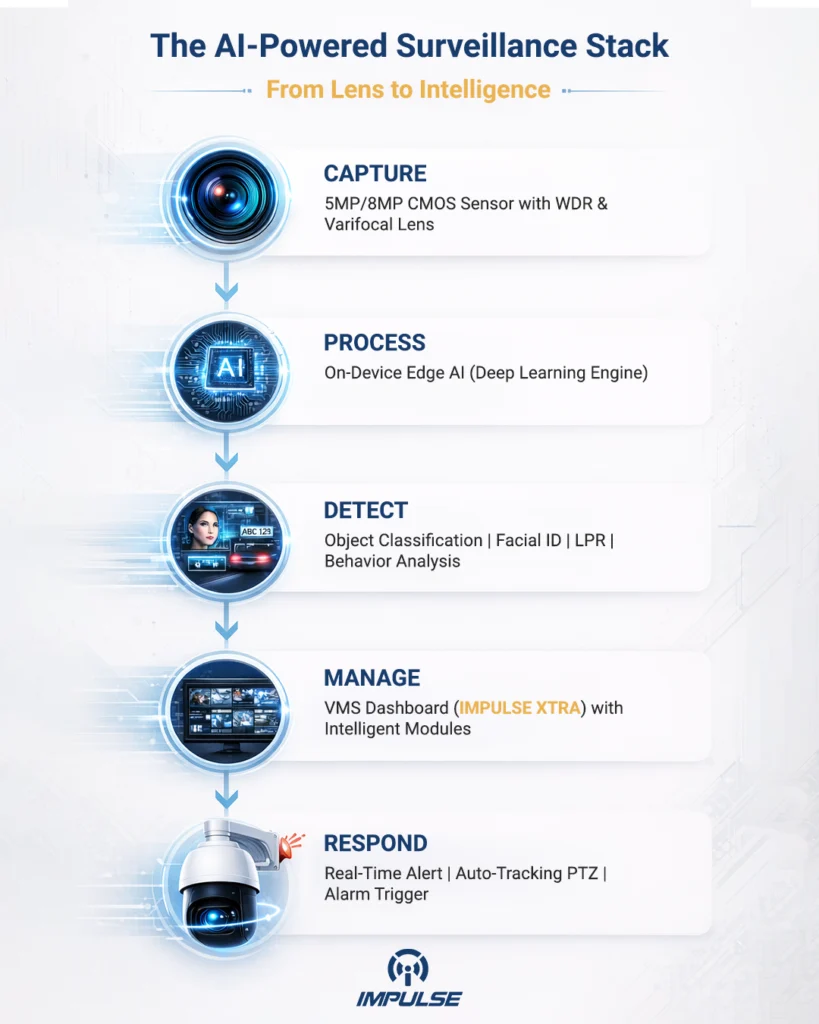
Artificial intelligence is the single most impactful force transforming modern video surveillance. Traditional motion detection has given way to deep learning-based edge analytics that can distinguish between humans, vehicles, animals, and objects, all in real time and without server-side processing.
Key AI capabilities now standard in enterprise-grade cameras include:
Facial Recognition & Re-identification: Cameras cross-reference individuals across multiple zones and camera feeds, enabling continuous subject tracking even across non-overlapping fields of view.
Behavioral Analysis: Systems detect loitering, perimeter breaches, crowd formation, and abnormal movement patterns, triggering alerts before incidents escalate.
License Plate Recognition (LPR): High-resolution optics combined with AI deliver accurate LPR even at highway speeds or in poor lighting conditions.
Object & Attribute Classification: Cameras equipped with deep learning can identify specific vehicle types, clothing colors, or carried items for post-event forensic analysis.
Impulse’s 5MP Varifocal Bullet Camera is a prime example of this shift, integrating edge analytics with deep learning directly on the device. This means real-time intelligent detection without the latency of cloud round-trips, backed by Wide Dynamic Range (WDR), Motion Detection, and Quad-stream support for flexible deployment in complex security environments.
Also worth reading: Explore how artificial intelligence is reshaping CCTV surveillance in 2025 in our in-depth analysis on the future of security.
2. High-Resolution Imaging: The Shift to 4K and Beyond
Resolution has long been a critical surveillance parameter, but the industry’s move from HD (1080p) to 5MP, 4K UHD (8MP), and beyond is enabling entirely new investigative capabilities. Greater pixel density means wider area coverage per camera, reduced total camera count in deployments, and significantly improved forensic zoom, allowing analysts to extract actionable detail from footage captured at a distance.
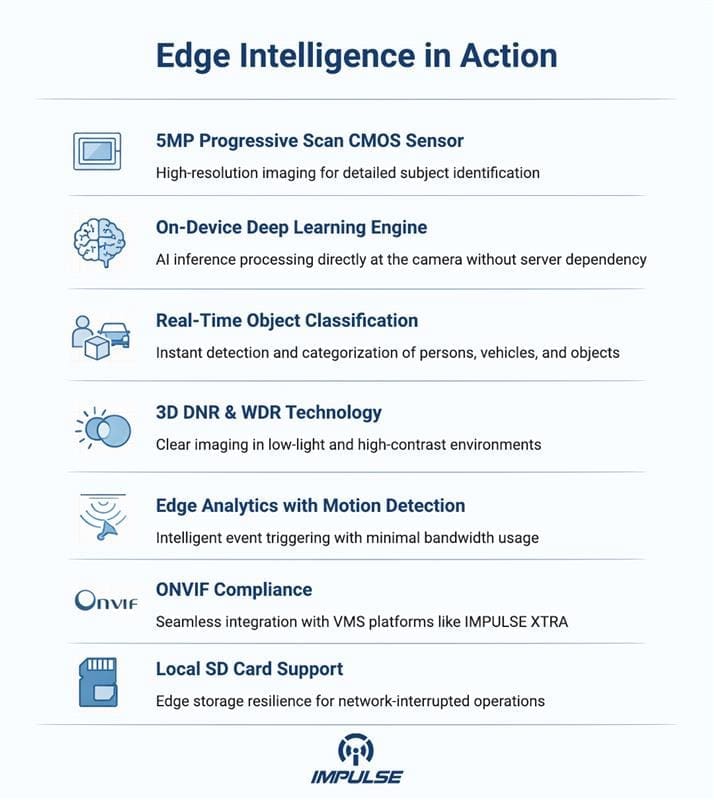
Modern high-resolution cameras now pair resolution with advanced sensor technology, including 1/2.7-inch and larger Progressive Scan CMOS sensors that deliver superior light sensitivity, reduced noise in low-light environments, and sharp imaging at high frame rates (2592×1944 @ 25/30fps).
Features like 3D DNR (Digital Noise Reduction), WDR (Wide Dynamic Range), and Ultra-Low Light performance ensure that high-resolution imaging doesn’t degrade in real-world conditions, whether facing direct sunlight, reflective surfaces, or poorly lit perimeters.
Impulse’s 5MP Motorized IR-Dome Camera delivers exactly this, combining a 5MP Progressive Scan CMOS with 3D DNR, a shutter range from 1/3s to 1/100000s, and up to 50 meters of IR range, making it an ideal choice for indoor/outdoor fixed surveillance in corporate and commercial settings.
3. PTZ Technology and Intelligent Auto-Tracking
Pan-Tilt-Zoom (PTZ) cameras have evolved from remotely operated tools to autonomous surveillance units capable of independently tracking subjects, executing preset tours, and responding to alarm triggers, all without operator intervention.
The latest generation of PTZ systems features:
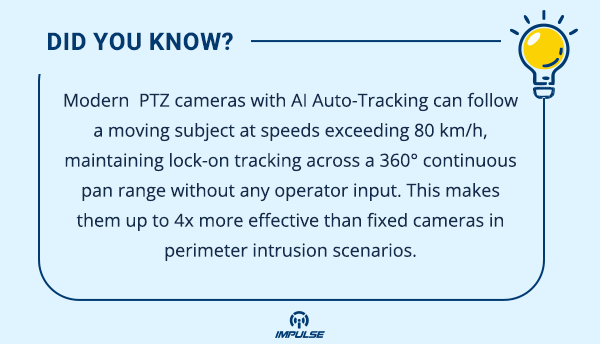
AI-Enabled Auto-Tracking: On-device algorithms lock onto a detected subject and continuously adjust pan, tilt, and zoom to maintain subject framing, critical for perimeter intrusion and high-security facilities.
Extended Optical Zoom: Optical zoom up to 40X enables distant subject identification that no fixed camera can achieve, making PTZ indispensable for large outdoor areas, ports, stadiums, and campuses.
Extended IR Range: Advanced PTZ cameras now deliver IR illumination up to 200 meters, enabling nighttime perimeter surveillance at scale.
Preset & Tour Modes: Operators can program specific monitoring positions and automated patrol routes, maximizing area coverage during low-staffing hours.
Line Scan & Perimeter Logic: Virtual tripwire and zone-entry detection ensure that any crossing or unauthorized approach triggers an immediate alert.
The PTZ IP Network Camera from Impulse embodies this capability, with 40X optical zoom, 200m IR range, 5MP resolution, and edge analytics supporting Auto-Tracking, Preset, Tour, Line Scan, and full ONVIF compliance for seamless integration into existing NVR/VMS ecosystems.
Related reading: NVR Security Systems for Facility Managers and Security Administrators – learn how to pair advanced cameras with the right recording infrastructure.
4. Edge Computing: Intelligence at the Camera Level
One of the most significant architectural shifts in modern surveillance is the migration of processing power from centralized servers to the camera itself. Edge computing in CCTV eliminates the need to stream raw video to a server for analysis; instead, the camera’s onboard processor runs the AI inference locally, sending only metadata, alerts, and flagged clips downstream.
Why edge computing matters for enterprise surveillance:
Bandwidth Efficiency: Only relevant data is transmitted, dramatically reducing network load, critical for large-scale deployments with dozens to hundreds of cameras.
Latency Reduction: Local processing enables sub-second alert generation, which is essential for real-time intrusion response and auto-tracking PTZ systems.
Resilience: Edge-processed cameras continue to operate and log intelligently even during network outages or server failures.
Privacy Compliance: On-device processing reduces the volume of raw facial or biometric data transmitted over networks, helping organizations comply with emerging data protection frameworks.
Cameras with SD card support and on-device analytics are purpose-built for edge deployments. Local buffering combined with smart event detection ensures that critical footage is retained even in network-interrupted environments.
See also: The Advantages of Using PoE in CCTV Systems – learn how PoE infrastructure supports efficient edge camera deployments.
5. 5G Connectivity and Cloud-Hybrid Surveillance Architectures
The mainstream rollout of 5G networks is set to transform surveillance infrastructure at scale. With theoretical throughputs exceeding 10 Gbps and latency below 1ms, 5G makes it viable to deploy wireless HD and 4K surveillance cameras in locations where wired infrastructure is cost-prohibitive, including remote perimeters, construction sites, temporary deployments, and transportation corridors.
Cloud-hybrid surveillance architectures are becoming the enterprise standard, combining:
Local Edge Storage: SD cards and on-site NVRs provide resilience and low-latency access to recent footage.
Cloud Archiving: Long-term footage retention, offsite backup, and multi-site centralized access via cloud platforms.
Remote Management: Security teams access live and recorded feeds from any device, anywhere, critical for multi-site enterprise operations.
Learn more: Security Cameras for Construction Sites – explore how wireless and cloud-connected surveillance solves challenges at remote and dynamic deployments.
6. Video Management Systems: The Intelligence Layer Unifying It All
As camera counts scale and analytics generate more data than ever, the Video Management System (VMS) has become the operational core of any serious surveillance deployment. A modern, enterprise-grade VMS is no longer simply a recording platform; it is a centralized intelligence hub that integrates feeds, manages alerts, enables forensic search, and supports intelligent modules for advanced decision-making.
Key capabilities of next-generation VMS platforms include multi-site management from a single dashboard, AI-assisted event filtering, mobile client access, open architecture for third-party integrations, and critically, the ability to support significantly more cameras per server than legacy platforms.
IMPULSE XTRA, Impulse’s enterprise-grade VMS developed in Canada, is purpose-built for this era. It supports four times more cameras per server compared to conventional VMS platforms, with a user-friendly interface, intelligent modules, full mobile client support, and reliability architecture designed for mission-critical deployments. For organizations managing large camera estates, this translates to significant savings in server hardware and operational overhead.
7. Cybersecurity in Surveillance: The Non-Negotiable Priority
As surveillance systems become more connected (IP cameras, cloud storage, remote access, VMS platforms), their attack surface expands proportionally. Cybersecurity is now an inseparable component of surveillance system design, not an afterthought.
Critical cybersecurity considerations for modern CCTV deployments:
Firmware & Patch Management: Cameras must support automatic or managed firmware updates to address newly discovered CVEs and vulnerabilities.
Encrypted Transmission: All video streams, especially over 5G or cloud pathways, should be encrypted using TLS/SSL and SRTP protocols.
Network Segmentation: Surveillance cameras should operate on isolated VLANs, preventing lateral movement in case of device compromise.
Strong Authentication: Default credentials must be replaced immediately on deployment; multi-factor authentication should be enforced for VMS and remote access.
ONVIF Compliance: Standardized protocols like ONVIF ensure interoperability while also enforcing baseline security capabilities across devices from different manufacturers.
Related: Best Industrial Security Cameras for Hazardous Environments – understand how ruggedized, compliant cameras address both physical and cyber resilience requirements.
8. Thermal Imaging, LiDAR, and Smart City Surveillance
The convergence of thermal imaging, multispectral sensors, and LiDAR with conventional CCTV is creating a new category of all-condition surveillance capable of operating in smoke, fog, complete darkness, and extreme weather – conditions that standard optical cameras cannot penetrate.
Thermal cameras detect infrared heat signatures, making them ideal for perimeter detection in zero-light conditions, particularly for critical infrastructure like power plants, data centers, and border facilities.
LiDAR integration in surveillance provides precise depth mapping and 3D scene reconstruction, enabling volumetric detection that standard 2D image analytics cannot achieve, relevant for smart city traffic management and autonomous facility monitoring.
Smart city surveillance platforms aggregate data from CCTV, IoT sensors, traffic systems, and public infrastructure into unified operational dashboards, enabling proactive response to emerging situations rather than reactive forensic review.
Conclusion
The future of CCTV and video surveillance technology is being defined by intelligence, connectivity, and integration. AI-driven analytics, high-resolution edge cameras, advanced PTZ systems, and enterprise VMS platforms are converging into a surveillance architecture that doesn’t just record; it understands, predicts, and responds.
Organizations that invest in these technologies today will build security infrastructure that scales with emerging threats, adapts to evolving regulatory requirements, and delivers measurable operational value beyond traditional loss prevention. Whether you’re designing a greenfield deployment or upgrading an existing system, understanding these trends is the first step toward building a future-ready surveillance ecosystem.
Impulse CCTV is committed to delivering surveillance technology that reflects these advancements, from intelligent edge cameras to enterprise VMS platforms, engineered for performance where it matters most.