

As surveillance installations increasingly embrace wireless connectivity, understanding the wireless network infrastructure that supports video transmission becomes mission-critical. The backbone networks handling wireless camera connectivity, video backhaul, edge device communication, and cross-site transmission now rely on Wi-Fi 6 (802.11ax) and the emerging Wi-Fi 7 (802.11be) standards.
This technical analysis examines the architectural differences, performance implications, and deployment considerations between Wi-Fi 6 and Wi-Fi 7 for surveillance network design in 2025 focusing on the infrastructure that enables high-throughput, low-latency video data movement across distributed security ecosystems, whether supporting wireless cameras or handling backhaul for wired installations.
The Infrastructure Challenge: Why Wi-Fi Standards Matter for Surveillance Networks
Modern surveillance systems generate massive data loads. A single 4K camera streaming at 8 Mbps H.265 compression can saturate legacy wireless links when multiplied across dozens of endpoints. Network engineers and system integrators must account for:
Aggregate bandwidth demand from concurrent video streams
Latency sensitivity for real-time monitoring and analytics processing
Spectrum congestion in dense deployment environments
Future scalability as AI-driven analytics increase bitrate requirements
The wireless infrastructure supporting wireless security cameras, remote access points, mobile surveillance units, temporary installations, and cross-building backhaul directly impacts system performance. Choosing between Wi-Fi 6 and Wi-Fi 7 becomes a question of current capacity versus long-term investment particularly as wireless camera adoption accelerates in retrofit scenarios where cable pulling is cost-prohibitive.
Technical Comparison: Wi-Fi 6 (802.11ax) vs. Wi-Fi 7 (802.11be)
Maximum Throughput and Channel Width
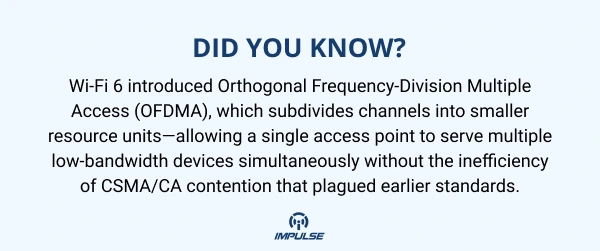
Wi-Fi 6 operates across 2.4 GHz and 5 GHz bands with maximum channel widths of 160 MHz, delivering theoretical peak throughput of 9.6 Gbps under optimal conditions. In practical surveillance deployments, expect 600–1200 Mbps per access point in dual-band configurations.
Wi-Fi 7 expands to the 6 GHz band (where spectrum regulations permit), supports 320 MHz channels, and utilizes 4096-QAM modulation yielding theoretical maximum throughput exceeding 46 Gbps. Real-world implementations will likely sustain 2–5 Gbps per AP, a 3–4× improvement over Wi-Fi 6.
Surveillance Impact:
High-resolution wireless cameras generating 15–20 Mbps per stream (4K/8MP at low compression) can exhaust Wi-Fi 6 APs when aggregated. Wi-Fi 7’s expanded bandwidth accommodates higher camera counts per access point and supports multi-gigabit backhaul for centralized NVR architectures critical whether your cameras connect wirelessly or your network infrastructure relies on wireless links between buildings or remote sites.
Latency Reduction and Deterministic Performance
Wi-Fi 6 introduced Target Wake Time (TWT) and improved MU-MIMO (Multi-User, Multiple Input, Multiple Output) to reduce latency. Typical latency ranges from 10–30 ms depending on network load.
Wi-Fi 7 implements Multi-Link Operation (MLO), enabling simultaneous transmission across multiple bands (2.4 GHz + 5 GHz + 6 GHz). This redundancy reduces packet loss and achieves sub-10 ms latency in congested environments critical for real-time video analytics and AI inference workloads processed at the edge.
Surveillance Impact:
Latency-sensitive applications facial recognition, perimeter intrusion detection, license plate recognition benefit from Wi-Fi 7’s deterministic performance. Systems utilizing wireless cameras or wireless-backhauled network segments that process video analytics will experience fewer dropped frames and faster alert generation.
Spectral Efficiency and Dense Deployment Scenarios
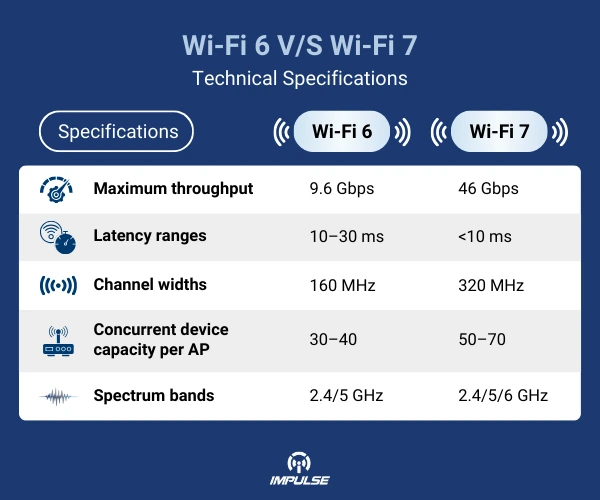
Wi-Fi 6 utilizes OFDMA and BSS Coloring to mitigate co-channel interference in dense environments. Each access point can handle 30–40 concurrent devices with acceptable Quality of Service (QoS).
Wi-Fi 7 enhances spectral efficiency through:
Multi-Resource Unit (MRU) allocation for dynamic bandwidth partitioning
Enhanced MU-MIMO supporting up to 16 spatial streams
Preamble Puncturing to avoid interference without abandoning entire channels
Surveillance Impact:
Large-scale installations airports, stadiums, enterprise campuses deploying hundreds of wireless cameras or mixed wired/wireless architectures benefit from Wi-Fi 7’s ability to serve higher device densities without performance degradation. Network planners can reduce AP count while maintaining throughput, lowering infrastructure costs.
Deployment Considerations for Surveillance Network Infrastructure
Backward Compatibility and Existing Infrastructure
Wi-Fi 6 maintains full backward compatibility with 802.11a/b/g/n/ac devices. Existing wireless cameras, encoders, and wireless bridges operate seamlessly on Wi-Fi 6 networks.
Wi-Fi 7 devices are backward compatible with Wi-Fi 6/5/4 clients but do not operate in tri-band MLO mode when serving legacy devices. Mixing Wi-Fi 7 APs with older wireless endpoints reduces the efficiency gains.
Recommendation:
Greenfield deployments or complete infrastructure overhauls favor Wi-Fi 7 for future-proofing. Phased upgrades in established networks should prioritize Wi-Fi 6 for cost-effectiveness, reserving Wi-Fi 7 for high-demand zones such as perimeter monitoring areas with PTZ wireless cameras or high-density camera clusters.
Power Consumption and Edge Device Support
Wi-Fi 6 introduced TWT to reduce power consumption for battery-operated devices—a significant consideration for wireless security cameras deployed in locations without PoE infrastructure.
Wi-Fi 7 does not fundamentally alter power profiles but improves data transmission efficiency, reducing airtime and indirectly lowering energy consumption for wireless camera transmissions and backhaul links.
Practical Note:
While many wireless cameras rely on battery power or solar+battery configurations, PoE-powered wireless bridges remain common for extending network reach. Understanding your deployment’s power topology is essential when selecting between Wi-Fi generations.
Cost and Availability in 2025
Wi-Fi 6 hardware is mature, widely available, and cost-competitive. Enterprise-grade access points range from $200–$600 per unit. Chipsets from Qualcomm, Broadcom, and MediaTek support most commercial applications, including wireless camera integration.
Wi-Fi 7 hardware entered volume production in late 2024. Early-generation equipment commands 40–60% price premiums over Wi-Fi 6. By mid-2025, expect pricing parity for mid-tier enterprise APs, though flagship Wi-Fi 7 routers with full 320 MHz channel support will remain premium-priced.
Budget Guidance:
Projects with 12–24 month timelines should specify Wi-Fi 6 unless specific use cases (ultra-low latency, >2 Gbps aggregate throughput per AP, dense wireless camera deployments) justify Wi-Fi 7 investment. Multi-year deployments benefit from Wi-Fi 7’s longevity.
Bandwidth Planning for High-Resolution Surveillance
Calculating Aggregate Throughput Requirements
For network engineers, accurate bandwidth planning requires:
Per-camera bitrate: 4MP @ H.265 = 6–8 Mbps; 8MP @ H.265 = 12–16 Mbps
Camera count per AP: Wi-Fi 6 (effective 800 Mbps) supports ~50 cameras at 4MP or ~25 at 8MP
Overhead factors: Protocol overhead (15–20%), QoS reservation (10%), redundancy buffering (10%)
Systems integrating analytics-capable cameras must account for metadata streams, alarm triggers, and bidirectional control traffic, adding 15–25% to baseline bandwidth calculations. This applies whether cameras transmit wirelessly or whether analytics processing occurs on network segments connected via wireless backhaul.
Wi-Fi 7’s advantage: Higher per-AP throughput reduces the need for dense AP deployments, simplifying infrastructure and reducing cabling complexity in retrofits particularly valuable when supporting high camera counts on wireless network segments.
Impulse supplies enterprise-grade surveillance equipment and works with system integrators to specify network infrastructure components that account for these bandwidth complexities whether supporting wireless installations or optimizing existing deployments for higher-resolution camera upgrades.
Understanding Bitrate Requirements Across Camera Types
When planning wireless surveillance networks, understanding the bandwidth demands of different camera configurations is essential:
Standard Resolution Cameras:
2MP (1080p) cameras typically stream at 4–6 Mbps using H.265 compression
4MP cameras range from 6–8 Mbps
5MP cameras typically require 8–12 Mbps depending on scene complexity and compression settings
High-Resolution and Analytics-Enabled Cameras:
8MP cameras with integrated smart analytics functionality can demand 12–20 Mbps
PTZ cameras with motorized zoom capabilities require additional bandwidth for control commands and high frame rate operation during tracking
These bitrate requirements remain consistent regardless of whether cameras connect via wireless or wired infrastructure—what changes is the aggregate load your wireless access points must handle when serving multiple wireless cameras or backhauling traffic from wired camera segments.
NVR Backhaul and Centralized Recording
Centralized recording architectures where multiple APs backhaul video streams to network video recorders require careful uplink planning. Wi-Fi 6 APs with 1 Gbps Ethernet uplinks can bottleneck when serving 20+ high-bitrate cameras wirelessly or when bridging wireless backhaul segments.
Wi-Fi 7 APs with 2.5 GbE or 10 GbE uplinks eliminate this bottleneck, supporting full-throughput wireless-to-wired bridging without frame drops. This matters in distributed surveillance topologies where wireless links connect remote camera clusters to centralized management systems, whether those cameras themselves are wireless or wired installations connected through wireless infrastructure segments.
For enterprise-grade recording platforms, the wireless infrastructure feeding these systems must be properly sized to prevent backhaul bottlenecks that degrade recording quality.
Wireless Camera Deployment Scenarios: When Each Standard Excels
Retrofit Installations and Temporary Deployments
Wi-Fi 6 serves as the practical choice for retrofit projects where running Ethernet cabling is cost-prohibitive or architecturally impossible. Historic buildings, leased facilities, and temporary event security benefit from Wi-Fi 6’s mature ecosystem and broad device compatibility with wireless cameras from multiple manufacturers.
Wi-Fi 7 becomes compelling in temporary high-security deployments (construction sites, special events, emergency response) where 4K wireless camera feeds must transmit reliably despite dense wireless environments and where rapid deployment timelines justify premium equipment costs.
Impulse provides surveillance solutions for challenging retrofit scenarios supplying equipment and technical specifications that help integrators evaluate whether wireless infrastructure investments in Wi-Fi 6 or Wi-Fi 7 align with their clients’ operational requirements and budget constraints.
Mixed Wired/Wireless Architectures
Modern surveillance installations often combine wired cameras in accessible locations with wireless cameras in challenging deployment areas. The wireless network infrastructure must support:
Direct wireless camera connectivity
Wireless bridges extending wired camera networks
Mobile surveillance units (vehicle-mounted cameras, body-worn devices)
Wireless links between buildings or remote structures
Wi-Fi 7’s superior spectral efficiency and multi-band operation make it ideal for these complex topologies, where a single AP might simultaneously serve wireless cameras, backhaul wired camera traffic, and support ancillary security devices.
High-Density Surveillance Environments
Stadiums, transportation hubs, and large retail facilities often deploy 100+ cameras across relatively confined spaces. Wi-Fi 7 APs handle 50–70 concurrent wireless devices compared to Wi-Fi 6’s 30–40, reducing infrastructure complexity and AP quantity while maintaining per-camera throughput.
For dense installations requiring analytics processing—such as deployments with 8MP cameras offering smart analytics capabilities—Wi-Fi 7’s low latency ensures metadata and alarm traffic doesn’t compete destructively with video streams.
Future-Proofing Surveillance Infrastructure: The 5-Year Outlook
AI-Driven Analytics and Edge Processing
As edge AI processors become standard in wireless security cameras, bandwidth requirements will shift. On-camera analytics reduce video stream bitrates (via event-triggered recording) but increase control plane traffic for model updates, configuration changes, and metadata transmission.
Wi-Fi 7’s low-latency, high-throughput characteristics align with this trend—supporting bidirectional AI workloads without sacrificing video quality during peak processing loads. Expect wireless cameras with advanced analytics to leverage Wi-Fi 7’s deterministic performance for real-time object classification and behavioral analysis.
IoT Convergence and Unified Network Design
Modern surveillance systems integrate access control, environmental sensors, and building automation. IT managers increasingly demand unified wireless infrastructure serving all endpoints—from wireless cameras to door controllers to environmental monitoring devices.
Wi-Fi 6E (6 GHz-capable Wi-Fi 6) offers a middle path for organizations not ready for Wi-Fi 7’s cost but requiring 6 GHz spectrum access. However, Wi-Fi 7’s superior spectral efficiency makes it the long-term choice for converged IoT + surveillance networks, particularly as wireless camera adoption expands.
As enterprise security ecosystems evolve toward converged architectures, Impulse supplies integrated surveillance equipment that supports not just today’s surveillance requirements, but tomorrow’s unified security and building management systems.
Regulatory and Spectrum Considerations
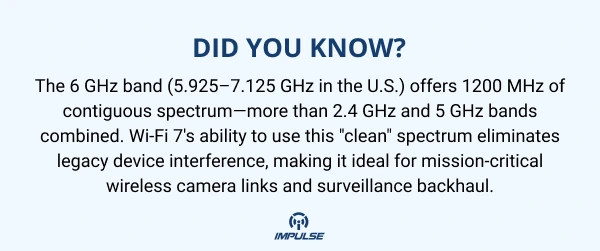
6 GHz spectrum availability varies globally. The U.S. (FCC), EU (ETSI), and parts of Asia have opened 6 GHz for unlicensed use, but adoption timelines differ. System integrators deploying multinational surveillance networks must verify regional spectrum regulations before specifying Wi-Fi 7-dependent wireless camera systems.
Wireless cameras operating exclusively on 2.4/5 GHz will function with both standards, but installations planning to leverage Wi-Fi 7’s full capabilities require 6 GHz regulatory approval in target deployment regions.
Practical Recommendations for 2025 Deployments
When to Choose Wi-Fi 6
Budget-constrained projects with <18-month deployment timelines
Retrofits adding wireless cameras to existing infrastructure
Moderate-density environments (<30 cameras per AP coverage area)
Deployments in regions without 6 GHz spectrum access
Installations using legacy wireless cameras lacking Wi-Fi 7 support
When to Choose Wi-Fi 7
Greenfield installations with 3–5 year lifecycle planning
High-density environments (stadiums, transportation hubs, campuses)
Latency-critical applications (real-time facial recognition, automated incident response)
Networks requiring >2 Gbps aggregate throughput per access point
Mixed architectures combining wireless cameras with wireless backhaul segments
Converged IoT + surveillance architectures
Hybrid Approach
Deploy Wi-Fi 6 for general coverage and Wi-Fi 7 in high-demand zones (perimeter monitoring, parking structures, remote buildings with dense wireless camera deployments). This balances cost and performance while future-proofing critical segments.
Consider Wi-Fi 7 for outdoor wireless bridges and backhaul links while maintaining Wi-Fi 6 for indoor wireless cameras—leveraging each standard’s strengths based on deployment context.
Conclusion
The debate between Wi-Fi 6 and Wi-Fi 7 for surveillance networks transcends simple throughput comparisons. Network engineers must evaluate latency requirements, spectral congestion, future scalability, and total cost of ownership—particularly as wireless camera adoption accelerates and surveillance architectures become increasingly distributed.
While Wi-Fi 6 remains the pragmatic choice for near-term deployments and retrofit projects, Wi-Fi 7’s architectural advancements—Multi-Link Operation, 320 MHz channels, and sub-10 ms latency—position it as the foundation for next-generation surveillance infrastructure supporting both wireless cameras and complex network topologies.
As video resolutions climb, AI analytics proliferate, and IoT convergence accelerates, the wireless infrastructure supporting these systems will determine operational success. System integrators and IT managers who invest in standards-based, future-ready wireless infrastructure today will avoid costly retrofits tomorrow—ensuring their surveillance networks deliver reliable, high-performance video transmission for years to come, regardless of whether cameras connect wirelessly or through wireless-backhauled wired segments.