


The wireless network has evolved from a convenience to a business-critical utility. Organizations no longer ask “Can we provide WiFi?” but rather “Can our infrastructure handle 500 concurrent HD video streams while supporting mission-critical IoT devices?” This fundamental shift demands a complete rethinking of wireless architecture one where capacity-based design and next-generation access points take center stage.
Modern enterprise wireless deployments must balance coverage, capacity, and cost-effectiveness while ensuring seamless connectivity across diverse environments. This technical deep-dive explores how leveraging advanced wireless access point architectures can transform your network infrastructure, enabling you to meet the escalating demands of bandwidth-intensive applications, mobile device proliferation, and mission-critical operations.

Understanding High-Density Wireless Environments
Defining Capacity-Based Deployments
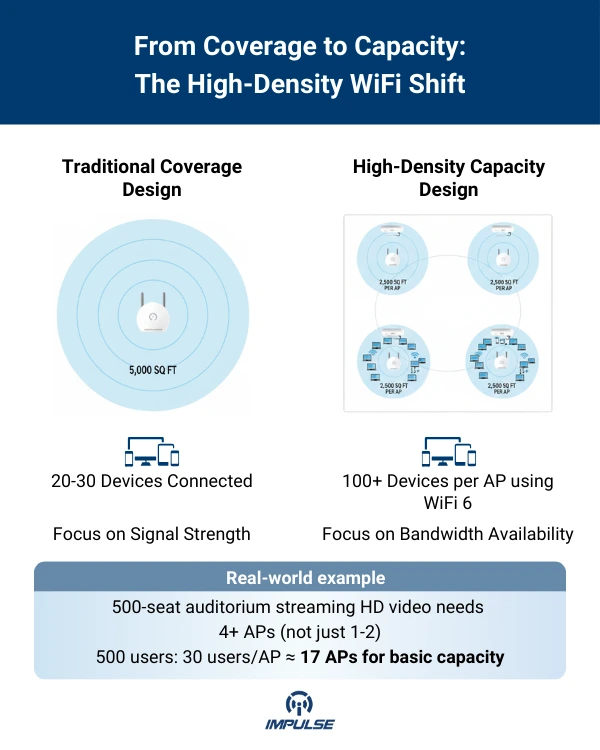
High-density wireless networks differ fundamentally from traditional coverage-based designs. While coverage-based deployments focus on maximizing signal strength across the largest possible area, capacity-based architectures prioritize bandwidth availability and connection stability in concentrated user zones. These environments include:
- Conference halls and auditoriums
- University lecture halls and libraries
- Sports stadiums and entertainment venues
- Corporate office spaces with BYOD policies
- Retail centers and hospitality facilities
- Healthcare campuses with critical IoT devices
In these scenarios, the challenge isn’t merely providing WiFi signal it’s ensuring that every connected device receives adequate throughput and maintains reliable connectivity even during peak usage periods.
The Scalability Imperative
Scalable network architecture becomes paramount when organizations anticipate growth or face unpredictable connection spikes. Traditional thin access point plus controller architectures often struggle under high-density conditions due to limited radio capacity, omnidirectional antenna constraints, and controller bottlenecks that throttle performance.
Modern deployments demand more intelligent solutions ones that leverage distributed processing, cloud-managed access points, and advanced RF optimization techniques to scale horizontally without introducing single points of failure.
Technical Foundation: WiFi 6 and Beyond
The WiFi 6 Advantage
The evolution from 802.11ac (WiFi 5) to 802.11ax (WiFi 6) represents a quantum leap in wireless technology. WiFi 6 introduces several game-changing features for high-density deployments:
- 1024-QAM (Quadrature Amplitude Modulation): Delivers 25% higher data rates compared to 256-QAM, significantly improving throughput in high-quality RF environments
- OFDMA (Orthogonal Frequency Division Multiple Access): Enables simultaneous multi-user transmissions by dividing channels into smaller resource units, dramatically reducing latency
- MU-MIMO (Multi-User, Multiple Input, Multiple Output): Supports concurrent data streams to multiple devices, increasing aggregate throughput
- TWT (Target Wake Time): Optimizes battery life for IoT devices by scheduling transmission windows
For enterprises deploying surveillance infrastructure, these advancements complement video management systems by ensuring IP cameras and network video recorders maintain consistent connectivity. For instance, when integrating advanced cameras like the 2MP Varifocal Camera with varifocal capability, a robust WiFi 6 backbone ensures uninterrupted streaming of dual streams and alarm data without bandwidth contention.
Dual-Band and Tri-Band Architectures
Implementing dual-band concurrent access points (2.4GHz and 5GHz radios) maximizes available spectrum and accommodates legacy devices while steering modern clients to less congested 5GHz channels. With the FCC’s allocation of 1,200 MHz of unlicensed spectrum in the 6GHz band, WiFi 6E and emerging WiFi 7 platforms are enabling tri-band deployments that further alleviate congestion in ultra-high-density scenarios.
Band steering technologies automatically guide dual-band capable devices to optimal frequency bands, balancing load across radios and preventing older 2.4GHz devices from monopolizing airtime during peak periods.
Design Principles for Scalable Deployments
Capacity Planning: Beyond Coverage
The traditional approach of conducting physical site surveys to minimize access point count is obsolete for high-density requirements. Instead, capacity-based planning calculates the number of access points necessary to meet aggregate bandwidth demands.
Capacity Planning Methodology:
- Identify Application Requirements: Determine per-user bandwidth needs for primary applications (video streaming, VoIP, cloud applications, etc.)
- Calculate Total Bandwidth: Multiply per-user requirements by expected concurrent users in each coverage zone
- Factor in Protocol Overhead: Account for 802.11 overhead (typically 40-50% of theoretical throughput)
- Determine AP Quantity: Divide total required bandwidth by realistic per-AP throughput
For example, a 500-seat auditorium where 80% of attendees will stream HD video (3 Mbps per user) requires:
- Active users: 500 × 0.8 = 400 users
- Total bandwidth: 400 × 3 Mbps = 1,200 Mbps
- Adjusted for overhead: 1,200 Mbps ÷ 0.5 = 2,400 Mbps theoretical
- APs required (assuming 600 Mbps per AP real-world): 2,400 ÷ 600 = 4 access points minimum
AP Placement and Overlap Strategy
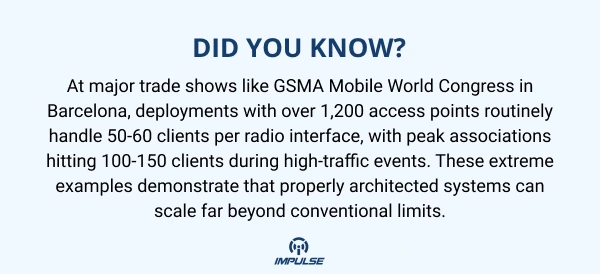
Strategic access point placement in high-density areas ensures clients always “see” two to three access points. This overlap enables seamless load balancing and provides redundancy if one AP becomes overloaded, clients can automatically transition to alternate access points without service degradation.
Critical design considerations include:
- Cell density: Maintain 2,000-2,500 sq ft coverage per AP in dense environments (compared to 5,000+ sq ft in standard deployments)
- Vertical mounting: Ceiling-mounted APs with professional antennas and beamforming provide superior line-of-sight compared to wall-mounted alternatives
- Channel planning: Implement non-overlapping channel schemes (1, 6, 11 on 2.4GHz; DFS channels on 5GHz) to minimize co-channel interference
- Power optimization: Reduce transmit power to prevent excessive cell overlap while maintaining adequate signal strength
When securing high-density venues with integrated surveillance, solutions like the 3MP Varifocal Dome Camera with Motorized Autofocus featuring motorized autofocus lenses and 120dB Ultra WDR benefit from strategically placed access points that ensure uninterrupted connectivity for analytics and recording functions across expansive areas.
Advanced Features for Density Management
Automated RF Optimization
Modern cloud-managed access points incorporate self-healing RF optimization systems that continuously adapt to changing conditions. These systems automatically adjust:
- Channel selection: Dynamic frequency selection (DFS) migrates APs to less congested channels
- Transmit power: Automatic power control prevents cell overlap interference
- Client roaming: Fast roaming protocols (802.11k, 802.11r, 802.11v) enable sub-50ms handoffs between APs
Unlike manual tuning approaches that become obsolete as the RF environment evolves, automated optimization maintains peak performance without constant administrative intervention.
Quality of Service (QoS) and Traffic Shaping
Layer 7 application traffic shaping at the network edge ensures bandwidth-intensive applications receive appropriate priority. Enterprise-grade access points with enhanced CPU and memory capabilities can enforce:
- Per-user bandwidth limits to prevent single devices from monopolizing capacity
- Application-based QoS policies that prioritize VoIP and video conferencing over background downloads
- VLAN-based traffic segregation for guest networks, corporate devices, and IoT infrastructure
For security deployments incorporating PTZ cameras such as the 2MP PTZ Camera with 40X optical zoom and edge analytics, QoS policies guarantee that surveillance traffic receives priority, ensuring auto-tracking and preset tour functions operate flawlessly even during network congestion.
Mesh Technology and Flexible Deployment
Wireless mesh architectures enable access points to interconnect wirelessly, extending coverage without requiring Ethernet backhaul to every AP. This technology proves invaluable for:
- Temporary high-density deployments (conferences, outdoor events)
- Historical buildings where cabling is impractical
- Rapid deployment scenarios requiring flexible infrastructure
- Cost-effective expansion of existing networks
Modern mesh implementations support multi-hop topologies while maintaining throughput and minimizing latency through intelligent path selection algorithms.
Integration with Security Infrastructure
Converged Networks: WiFi and Surveillance
Modern enterprises increasingly deploy converged network infrastructure where wireless connectivity and IP-based surveillance systems share the same backbone. This convergence demands careful planning to ensure:
- Sufficient bandwidth allocation: IP cameras, especially high-resolution models with dual streaming and analytics capabilities, consume substantial bandwidth
- Power over Ethernet (PoE) capacity: Both wireless APs and IP cameras rely on PoE switches—ensure adequate power budget across the infrastructure
- Network segmentation: Isolate surveillance traffic on dedicated VLANs to prevent interference with user data
- Redundancy protocols: Implement failover mechanisms to maintain surveillance continuity during network disruptions
When architecting unified systems, consider how wireless access points and surveillance devices complement each other in delivering comprehensive security solutions without compromising performance.
Edge Analytics and Distributed Intelligence
The shift toward edge computing enables processing video analytics and AI-driven insights directly at network endpoints rather than transmitting all data to centralized servers. This distributed approach:
- Reduces bandwidth consumption by filtering and processing locally
- Decreases latency for real-time decision-making
- Enhances privacy by minimizing data transmission
- Scales more efficiently as endpoint density increases
Access points with enhanced computational resources can support edge applications beyond connectivity, transforming them into multi-function infrastructure nodes.
Best Practices for Deployment and Maintenance
Pre-Deployment Considerations
1. Conduct Comprehensive Site Surveys Utilize RF planning tools like AirMagnet or Ekahau to identify potential interference sources, optimal mounting locations, and preliminary channel allocations.
2. Assess Backhaul Requirements Ensure sufficient Ethernet infrastructure (preferably Cat6/Cat6a for multi-gigabit support) and aggregation layer switching capacity to handle cumulative AP throughput.
3. Plan for Power Redundancy Deploy PoE+ (802.3at) or PoE++ (802.3bt) switches with backup power systems to maintain network uptime during outages.
4. Establish Baseline Metrics Document pre-deployment performance benchmarks for comparison after installation.
Post-Deployment Optimization
1. Stress Testing Fully load the network with simulated or actual user traffic to validate capacity assumptions and identify bottlenecks before production deployment.
2. Continuous Monitoring Implement network management platforms that provide visibility into client connections, throughput, roaming patterns, and interference sources.
3. Iterative Refinement Regularly review performance data and adjust AP placement, power levels, channel assignments, and QoS policies based on actual usage patterns.
4. Firmware Currency Maintain current firmware across all access points to ensure security patches, feature enhancements, and bug fixes are applied consistently.
Security Hardening
High-density environments present attractive targets for security threats. Implement comprehensive security measures including:
- WPA3 encryption with Enterprise authentication (802.1X)
- Network Access Control (NAC) to validate device compliance before granting access
- Intrusion Detection/Prevention Systems (IDS/IPS) to identify and block malicious traffic
- Captive portal authentication for guest networks with automatic session timeouts
- Rogue AP detection to identify unauthorized devices broadcasting SSIDs
Scalability Considerations and Future-Proofing
Horizontal Scaling Models
Unlike traditional controller-based architectures where a single hardware controller becomes a performance bottleneck, distributed control plane architectures enable linear scalability. Each access point independently handles packet processing, firewall enforcement, and application QoS, allowing organizations to simply deploy additional APs as capacity requirements grow.
Cloud-Native Management Benefits
Cloud-managed wireless platforms offer several advantages for scalable deployments:
- Centralized visibility: Monitor thousands of APs across multiple locations from a single dashboard
- Zero-touch provisioning: New APs automatically download configurations upon network connection
- Firmware orchestration: Schedule updates across entire fleets without manual intervention
- Predictive analytics: Machine learning algorithms identify performance degradation before users experience issues
- Flexible licensing: Pay-as-you-grow models align costs with actual deployment scale
Investment Protection
Wireless technology continues evolving rapidly. Protect long-term investments by selecting access points that support:
- Software-defined features: New capabilities delivered via firmware rather than hardware replacement
- Modular upgrades: Platforms supporting future radio module swaps (e.g., WiFi 7 upgrades)
- Open standards compliance: Avoid vendor lock-in through support for standard protocols
- Backward compatibility: Maintain support for legacy devices during transition periods
Conclusion
Deploying scalable, high-density wireless networks represents both a technical challenge and a strategic opportunity. Organizations that master capacity-based design principles, leverage next-generation wireless standards like WiFi 6/6E, and implement intelligent management platforms position themselves to deliver exceptional user experiences regardless of connection density.
The convergence of wireless infrastructure with critical systems including IP surveillance, IoT sensors, and mission-critical applications demands holistic planning that considers bandwidth allocation, security segmentation, and distributed intelligence. By embracing automated RF optimization, cloud-managed architectures, and best practices for AP placement and load balancing, enterprises can build wireless foundations that scale seamlessly from hundreds to thousands of concurrent connections.
As bandwidth demands continue escalating and device proliferation shows no signs of slowing, the question isn’t whether to invest in high-density wireless infrastructure it’s how quickly you can deploy solutions capable of meeting tomorrow’s requirements today. With proper planning, modern technology adoption, and ongoing optimization, your wireless network can transform from a basic connectivity utility into a competitive advantage that enables innovation, enhances security, and supports business growth.